What grass does Wimbledon use: mowing, lines and stripes explained
Why the Wimbledon lawn survives two weeks of tournament play: the grass species, daily cut height, annual renovation, court line rules, and what actually causes the light-dark stripes.
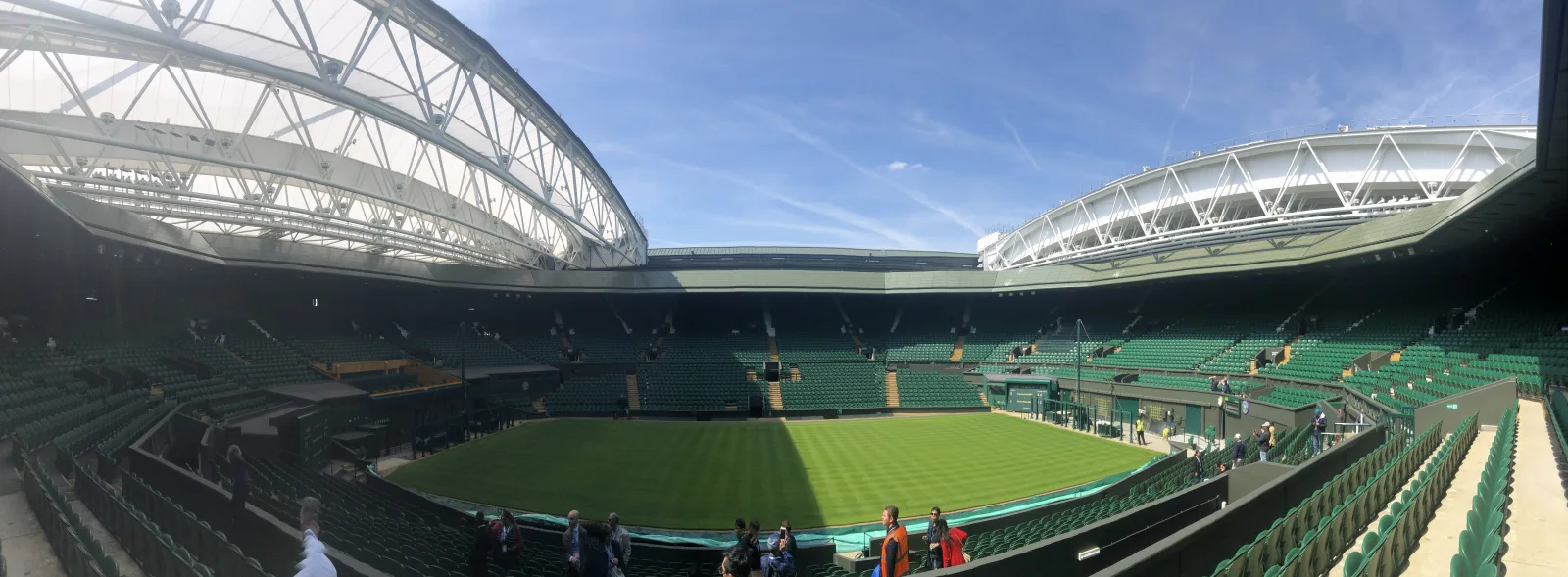
Why the final rounds are also played on the turf itself
As the tournament moves into its closing days, the cameras start lingering on something easy to miss early on: the court is no longer uniform. Near the baseline and in the service corridors the grass thins out and bare soil starts to show through, while the rest of the court stays a solid green carpet. That is not neglect — it is the predictable result of two weeks of professional-level play on turf that, for the rest of the year, never experiences anything close to that intensity.
Behind that court sits a maintenance operation closer to a golf green than a home lawn, but with a few principles that scale down surprisingly well to an ordinary garden. Here is what the All England Lawn Tennis Club (AELTC) grounds team actually does, with verified figures rather than folklore.
What grass Wimbledon uses: 100% Perennial Ryegrass since 2001
Until 2000 the courts were sown with a mix of 70% Perennial Ryegrass (Lolium perenne) and 30% Chewings/Creeping Red Fescue — the same fine fescue found in many ornamental UK lawn mixes. From 2001 the AELTC switched to 100% Perennial Ryegrass, because fescue simply could not withstand two weeks of high-intensity professional play: it thinned out too fast, leaving bare patches exactly where the surface needed the most durability.
The species change had a measurable knock-on effect on the game itself: former head groundsman Eddie Seaward has described the difference in ball response time between the old and new grass as roughly a tenth of a second — enough to make the bounce slightly slower and higher, evening the game out. That change, combined with other technical factors like racquets and strings, coincided with serve-and-volley points dropping from about 33% in 2002 to roughly 7% by 2018. Perennial ryegrass is the same species SprinklerMap lists as an option in the vegetation panel (see Vegetation Types in SprinklerMap: How ET Coefficients Drive Your Watering Schedule): it is also the cool-season grass with the highest water demand in that panel, ET 5.3 mm/day, consistent with a lawn irrigated and maintained on a budget no residential garden could realistically match.

The daily cut: from 13 mm in winter to 8 mm during the Championships
In winter the Wimbledon grass is kept at 13 mm. From March the height drops gradually, about 1 mm every two weeks, down to the playing height of 8 mm — the standard adopted in 1995 and held for the whole tournament. During the Championships mowing happens daily, done by hand with battery-powered cylinder (reel) mowers from Toro — the same mechanical principle as a rotating cylinder against a fixed blade, which gives a cleaner, more even cut than the rotary mowers common in home gardens.
Outside the tournament the pace eases off: mowing every other day during the spring growth season, not daily. For a concrete comparison: a well-kept residential lawn in the UK is typically cut at 30-40 mm, nearly 4-5 times taller than Wimbledon's playing height. That is not a detail to skip if you are tempted to copy the look — more on that below.

The renovation after the final: 9 tonnes of seed and months of work
The day after the final, the least photographed but most labour-intensive phase begins: the complete renovation of all 18 Championship courts (plus 20 practice courts). The old surface is removed, the ground is deep-aerated (vertidraining) to break up compaction built up during the tournament, and then comes reseeding — over 9 tonnes of perennial ryegrass seed every year — followed by about 6 tonnes of top-dressing (fine soil) to level the surface.
The permanent grounds staff of 18 grows to 31 during the Championships to keep pace with daily court care. The courts need to be playable for club members again within the week after the final, but full establishment of the new turf continues for months afterwards, with dedicated treatments from April onward to repair any winter frost damage. It is a cycle that repeats identically every year, regardless of who lifts the trophy.

Why the grass thins near the baseline in the second week
It is not disease and it is not an irrigation problem — it is pure foot-traffic wear. In the zones where players move most — behind the baseline and in the service side corridors — leaf blades and stems break down and soil starts showing through, cutting density exactly where the surface needs the most resilience. The effect is measurable: ball bounce goes from roughly 23-24 cm in the first week to 26-28 cm in the second, a higher, less predictable bounce that players have to adjust to in the closing rounds.
It is the same principle, on a much smaller scale, as a home lawn with a habitual path across it — the route to the gate, the patch under the kids' swing set: repeated foot traffic compacts the soil and wears out the grass faster than any watering schedule can compensate for. If you have a spot like that in your garden, it is often better to accept it as a path (perhaps with mulch or stepping stones) than to keep reseeding it every year.
Court lines: materials and rules
ITF rules set tennis court line width between 2.5 and 5 cm, except the baseline, which can be up to 10 cm — the widest line because it needs to stay clearly visible even in long-range TV shots. At Wimbledon lines are painted with a wheeled line-marking machine using a titanium-dioxide-based compound: 50 mm wide for standard lines, 100 mm for the baseline, with total annual consumption estimated at around 500 gallons (nearly 1,900 litres) of compound across all 18 Championship courts and 20 practice courts.
During the tournament lines are repainted frequently — sometimes between matches on the most heavily used courts — to stay crisp for both line judges and cameras. The compound used on grass courts is formulated not to damage the turf underneath, a real difference from the permanent paints used on hard or clay courts, where the surface does not need to keep growing beneath the line.
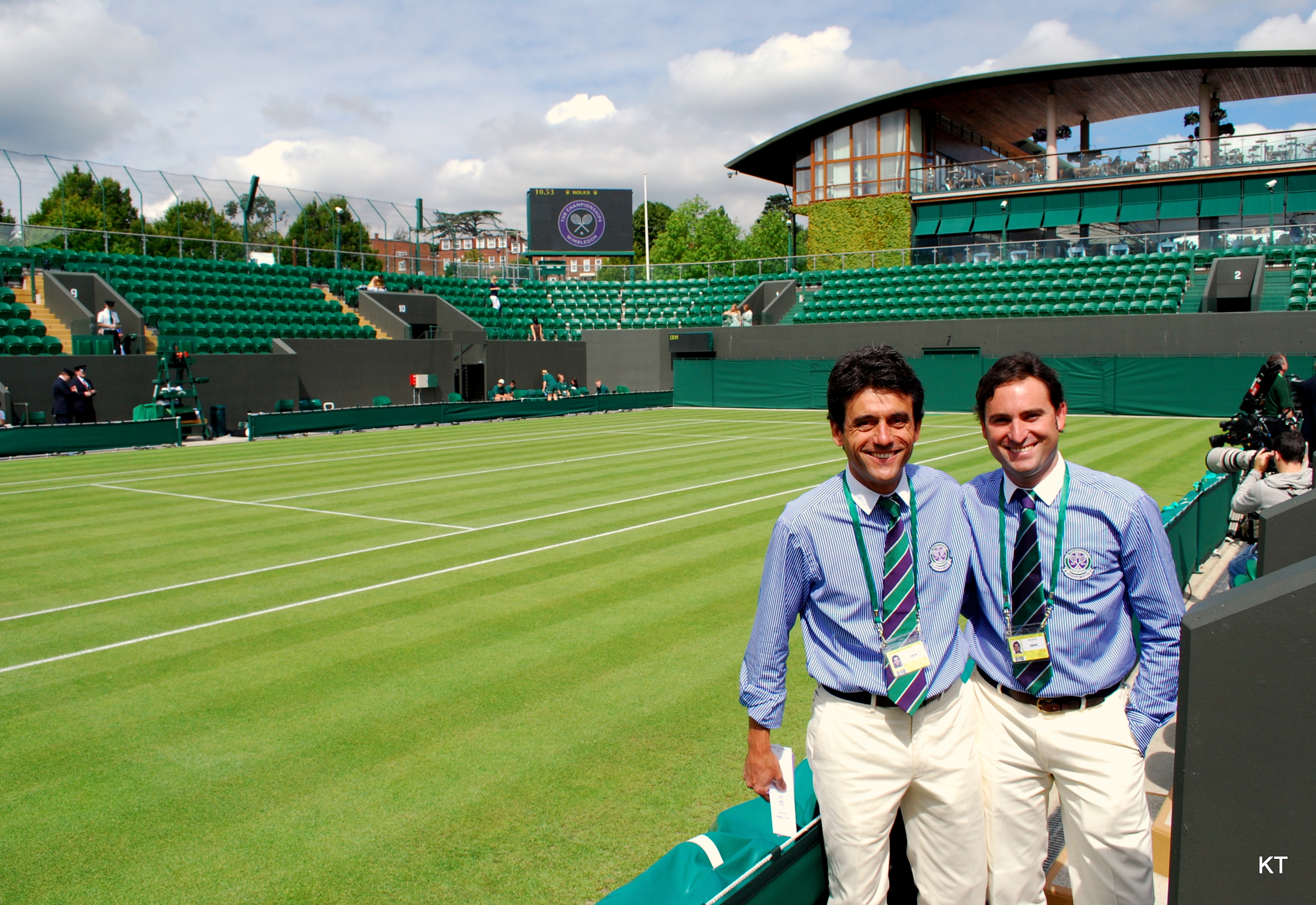
The light-dark stripes: it is not a different cut, it is light
Looking at a freshly mown court — not just at Wimbledon, but on a football pitch or a home lawn cut with a cylinder mower — you notice alternating light and dark bands. They are not caused by a different cutting height or a different colour of grass: it is an optical effect caused by the direction the roller behind the blade bends the grass blades as the mower passes.
Where the grass is bent away from the viewer, you see the wide surface of the blade, which reflects more light and looks lighter. Where the grass is bent toward the viewer, you mostly see the tips and shadows of the blades, and the stripe looks darker. It is the same principle that makes football pitches look chequerboarded on TV: no chemical treatment, no real difference in the grass, just the physics of light and the direction of the roller.

What you can copy for your own lawn (and what you should not)
Stripes are achievable on a residential lawn too, with a cylinder mower fitted with a rear roller (instead of the standard rotary mower with a grass-collection bag): the principle is identical, only the scale changes. What you should NOT copy is the cutting height: dropping to 8 mm on a home lawn without Wimbledon's budget, daily watering and grounds staff will drastically weaken the roots, expose the soil to direct sun, and make the lawn far more vulnerable to drought and weeds. For a UK residential lawn, the 30-40 mm mentioned above remains far more realistic, adjusted for soil type (see How long to run sprinklers: minutes per cycle by soil and head type, with the math behind them) and the species sown.
If your lawn is already Perennial Ryegrass-based — or you are planning to sow one, perhaps with a self-repairing line like Barenbrug RPR Lawn — it is worth knowing it is the same species used at Wimbledon, but how you treat it (height, mowing frequency, watering) matters more than the species itself in determining how well it stands up to your family walking on it. For a comparison of seed mixes available in Europe, see Lawn seed types: brands, mixes and what to choose.
Recommended products
These product links are affiliate links: if you buy on Amazon through them it costs you nothing extra, but it helps us keep SprinklerMap alive as a project and create new useful content.
These products are catalogued in our brand database, with the same description and price range you find on the manufacturer page.

| Model | Type | Description | Radius (m) | Price (€) | Buy |
|---|---|---|---|---|---|
| 🌱 RPR Lawn | Seeds | Mixture with self-repairing ryegrass for recreational lawns. Suited to gardens used by children, pets and frequent foot traffic. | — | €20-60 | Amazon |

.jpg)


| Model | Type | Description | Radius (m) | Price (€) | Buy |
|---|---|---|---|---|---|
| 🌱 Royal Sport | Seeds | Mixture for turf under intensive use. Designed for fast recovery, foot traffic and more frequent maintenance. | — | €90-180 | Amazon |
Other suggested products
Products not in the brand catalogue: generic material, tools and accessories where the right size matters more than the brand.
| Product | Description | Price (€) | Buy |
|---|---|---|---|
| Cylinder mower with rear roller for a striped lawn | Cylinder mower with rear roller — the same mechanical principle used on grass tennis courts to get the classic light-dark striped effect on a home lawn. | ~€£150-450 | Amazon |
| Manual lawn roller | Water- or sand-fillable roller for levelling the ground and sharpening the striped effect after mowing. Also useful after sowing to ensure good seed-to-soil contact. | ~€£40-90 | Amazon |
| Manual lawn scarifier/aerator | Manual roller-type scarifier with tines for removing thatch and breaking up soil compaction in high-traffic areas before overseeding. | ~€£25-60 | Amazon |
Technical note: Germination times, seed rates and seasonal windows given in this article vary with the species you choose, your local climate and your starting soil conditions. Treat these figures as an average reference and adjust them based on how your seeding actually progresses, especially if you're in an area with very cold winters or very hot summers.