Drip irrigation for hedges and shrubs: design and installation
How to design and install drip irrigation for hedges: pressure-compensating emitters, pipe layout and scheduling.

Why drip is the right choice for hedges and shrubs
Hedges and ornamental shrubs have shallow, laterally spreading root systems concentrated in the top 30–40 cm of soil. Pop-up spray heads designed for lawns deliver water across an entire arc — most of which falls on foliage or bare ground between shrubs rather than at the root zone. The result is wasted water, wet foliage (which promotes fungal disease), and uneven plant growth as some shrubs receive more water than others.
Drip irrigation delivers water directly to the base of each plant via small emitters inserted along a tube. Evaporation is near zero. Foliage remains dry. Water reaches exactly where roots need it. Drip systems typically use 30–50% less water than overhead spray for the same row of shrubs, and plants show noticeably more uniform growth when each receives a consistent, measured supply.
Types of emitters for hedges and shrubs
Two emitter types dominate hedge and shrub drip installation: individual point emitters and inline drip tape.
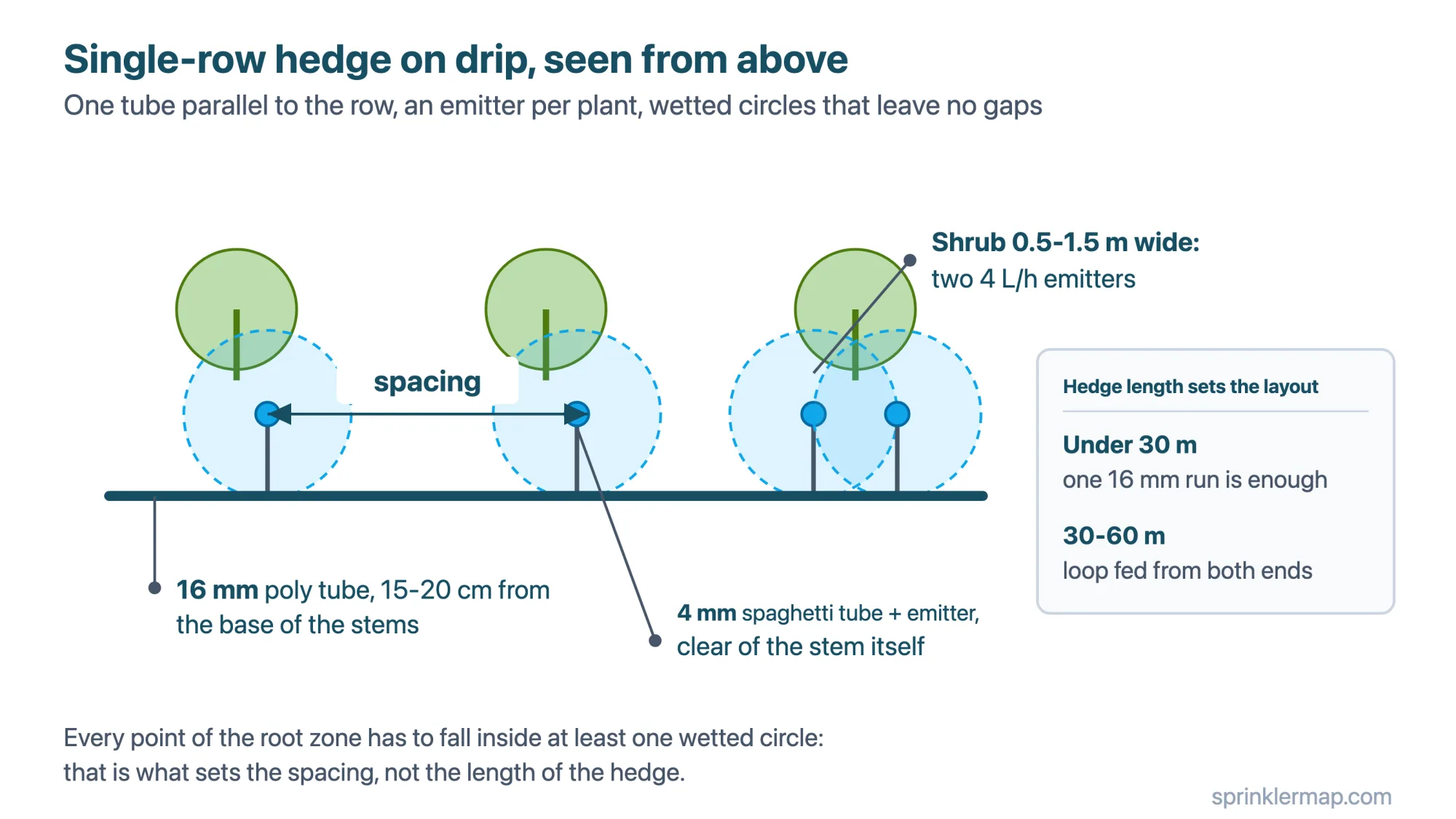
Individual emitters punch into the main 16 mm poly tube and emit water at a fixed rate (2 L/h or 4 L/h). They are ideal for widely spaced shrubs where you want one or two emitters per plant. For a young shrub under 50 cm spread, one 2 L/h emitter is sufficient; for an established shrub 0.5–1.5 m wide, two 4 L/h emitters on opposite sides; for large specimen plants or small trees, four emitters arranged as a ring around the drip line.
Inline drip tape has emitters pre-installed every 20–30 cm along the tube. It works best for continuous single-row hedges where individual emitter placement would be impractical. Lay the tape parallel to the hedge stems, connect to the 16 mm main line, and mulch over it. One pass of tape per hedge row covers all stems uniformly.

Pressure-compensating emitters: why they matter
Always use pressure-compensating (PC) emitters for hedge and shrub drip. PC emitters maintain constant output — 2 or 4 L/h — across a wide pressure range (typically 1–3.5 bar). Non-compensating emitters vary their flow with line pressure, meaning emitters near the zone valve receive significantly more water than those at the end of a long run.
On a 40 m hedge with a single zone valve, line pressure at the far end may be 0.5–1 bar lower than at the inlet. Non-compensating 2 L/h emitters deliver 1.2 L/h at the far end and 2.8 L/h at the start — the nearest shrubs receive more than twice the water of the farthest. PC emitters eliminate this imbalance entirely.
Designing the layout: single-row hedge
For a single-row hedge, the standard layout is one run of 16 mm poly tube parallel to the hedge line, positioned approximately 15–20 cm from the base of the stems. Connect the tube to the zone valve, install a 120–200 mesh filter immediately downstream of the valve, and fit a pressure reducer set to 1.5–2 bar if line pressure exceeds 3 bar.
For hedges under 30 m long: one run of 16 mm tube is sufficient. For 30–60 m hedges: add a return line on the other side of the stems, creating a loop that feeds from both ends and keeps pressure even throughout. For hedges over 60 m: split into two zones.
End each tube run with an end cap for pressurised lines, or a flushing end cap that allows the end to be opened periodically to flush sediment.
Designing the layout: multi-row shrub beds
For irregularly planted shrub beds, use a main 16 mm tube as a spine through the bed, then branch individual 4 mm micro-tubes (spaghetti tubes) from it to each plant. Each micro-tube terminates at the plant base with a stake-mounted emitter.
This "octopus" layout lets you adjust the number of emitters per plant based on size: one emitter for small plants, two for medium, four for large specimens. It is more time-consuming to install than hedge tape but gives precise, plant-by-plant control — essential in mixed beds where plants have widely varying water demands.
Flow calculation and zone sizing
Total zone flow = number of emitters × emitter flow rate. A 40 m hedge with inline tape at 2 L/h every 30 cm has approximately 133 emitters; total zone flow = 133 × 2 L/h = 266 L/h = 4.4 L/min. This is comfortably within a domestic water supply (typically 300–500 L/min capacity) and well within a standard solenoid valve rating.
For zones with many emitters, check the maximum flow rating of the 16 mm tube: standard drip tube handles up to approximately 180–200 L/h before friction losses make pressure uniformity poor. If your zone exceeds this, split into two runs or step up to 20 mm main tube.
Scheduling: less frequent but deeper watering
Shrubs and hedges benefit from infrequent, deep watering rather than daily light irrigation. Deep watering encourages roots to grow downward, which makes plants more drought-tolerant and reduces the need for irrigation in cool or rainy periods.
Typical schedule for established shrubs in summer: twice a week, 1–2 hours per session, delivering 2–4 L per plant per session depending on species and soil. For a newly planted hedge in its first season, water three times a week until roots establish — usually 4–6 weeks. After establishment, reduce to the twice-weekly schedule.
Key takeaways
Drip is the definitive choice for hedges and shrubs — not pop-up spray heads. Always use pressure-compensating emitters for lines over 15 m. Install a 120–200 mesh filter at every drip zone inlet. For single-row hedges, one 16 mm tube parallel to the stems with inline tape or individual emitters is the standard layout. For mixed shrub beds, a 16 mm spine with 4 mm micro-tube branches per plant gives plant-by-plant control. Water deeply and infrequently to encourage drought-tolerant root growth.
Frequently asked questions
Can I share a drip zone for hedges and a lawn spray zone?
No. Drip and spray need different pressures (drip: 1.5–2 bar; spray: 2.5–3.5 bar) and very different run times. Always keep drip and spray on separate zones with separate solenoid valves.
My hedge has some old, established shrubs and some newly planted ones in the same row. How do I manage the different water needs?
Install individual emitters rather than uniform inline tape. Give newly planted shrubs 4 L/h emitters (or two 2 L/h emitters), and established shrubs 2 L/h emitters. As the new plants establish over 1–2 seasons, you can replace their emitters with the same flow rate as the mature shrubs.
How do I know if my drip emitters are working?
Run the zone for 15 minutes, then lift the mulch at a few random emitter locations and look for a moist soil patch 10–15 cm in diameter around each emitter. A clogged emitter will have dry soil. Clogged emitters are almost always caused by a dirty filter — clean the inlet filter first before replacing individual emitters.
Recommended products
These product links are affiliate links: if you buy on Amazon or AliExpress through them it costs you nothing extra, but it helps us keep SprinklerMap alive as a project and create new useful content.
These products are catalogued in our brand database, with the same description and price range you find on the manufacturer page.

| Model | Type | Description | Radius (m) | Price (€) | Buy |
|---|---|---|---|---|---|
| 🌿 XF Dripline | Drip | Pressure-compensating drip line for beds and hedges. Uniform flow from 0.5 to 5 bar pressure. | — | €90-160 | Amazon |

| Model | Type | Description | Radius (m) | Price (€) | Buy |
|---|---|---|---|---|---|
| 🌿 Techline CV | Drip | Pressure-compensating drip line for landscaping and vegetable gardens. 1.6 L/h flow, 30 cm spacing, works from 0.7 to 4 bar. | — | €90-170 | Amazon |
Other suggested products
Products not in the brand catalogue: generic material, tools and accessories where the right size matters more than the brand.
| Product | Description | Price (€) | Buy |
|---|---|---|---|
| Rain Bird pressure-compensating emitters 2 L/h (25-pack) | Rain Bird pressure-compensating drip emitters, 2 L/h, constant output from 1 to 4 bar. Brown UV-resistant body, barb fitting for 16 mm PE tube. Best for hedge lines over 30 m. | ~€15-25 | Amazon |
| Netafim 16 mm drip tape 30 cm spacing | Netafim drip line with integrated emitters every 30 cm, 1.6 L/h per emitter. Clog-resistant, compatible with unfiltered tap water. Perfect for continuous hedges and border beds. Sold in 100 m rolls. | ~€40-70 / 100m | Amazon |
| Y-filter 3/4" 120-mesh for drip irrigation | Brass or plastic Y-filter with 120-mesh screen for drip systems. Standard 3/4" BSP connections. Easy clean without removing from line. Essential upstream of every drip emitter zone. | ~€8-18 | Amazon |
| 1-zone battery-powered timer for standalone drip | Single-zone battery-powered irrigation timer. Attaches directly to outdoor tap. 1–2 year battery life on 2 AA cells. Ideal for adding an independent drip zone for hedges without expanding the main controller. | ~€20-40 | Amazon |
| Product | Description | Price (€) | Buy |
|---|---|---|---|
| Drip line 16 mm, 30 cm spacing | Roll of pipe with built-in emitters for continuous runs along hedges and rows. Check the stated spacing: under 2 L/h the flow is less forgiving. | ~€12-35 | AliExpress |
| Y filter 3/4", 120 mesh | Washable screen filter to fit upstream of any drip line: without it, emitters clog within a season. | ~€6-15 | AliExpress |
| Battery tap timer, single zone | Battery-powered mechanical or digital timer for one line: useful on a terrace, hedge or veg patch where running power makes no sense. | ~€10-25 | AliExpress |
Technical note: The watering times and frequencies given in this article are reference values calculated for average climate and soil conditions. Your garden's actual needs depend on your local microclimate, soil type, sun exposure and plant species: use these figures as a starting point and adjust them based on how your lawn or plants respond in the first few weeks.