Hydrozones: split your garden to irrigate better
Hydrozone planning assigns the right amount of water to each area and is one of the most effective ways to save water.

What a hydrozone is, in plain terms
A hydrozone is simply a group of plants that drink about the same amount of water, wired to the same valve so they get watered together. The idea is intuitive: thirsty plants share one circuit, drought-tolerant plants share another. (A circuit, or zone, is one group of sprinklers controlled by a single valve.)
Without hydrozones, a single-zone system forces a bad compromise. Either you overwater the tough plants to keep the thirsty ones happy, or you starve the thirsty ones to protect the tough ones. Something always suffers — usually showing up as yellow patches or, at the other extreme, root rot.
Grouping is not only about how often you water, but how. Some plants are fine with overhead spray (lawn, vegetables); others prefer water delivered straight to the roots (lavender, rosemary and most Mediterranean shrubs, which rot if their leaves stay wet).
The drawn example: a real 90 m² with a patio to exclude
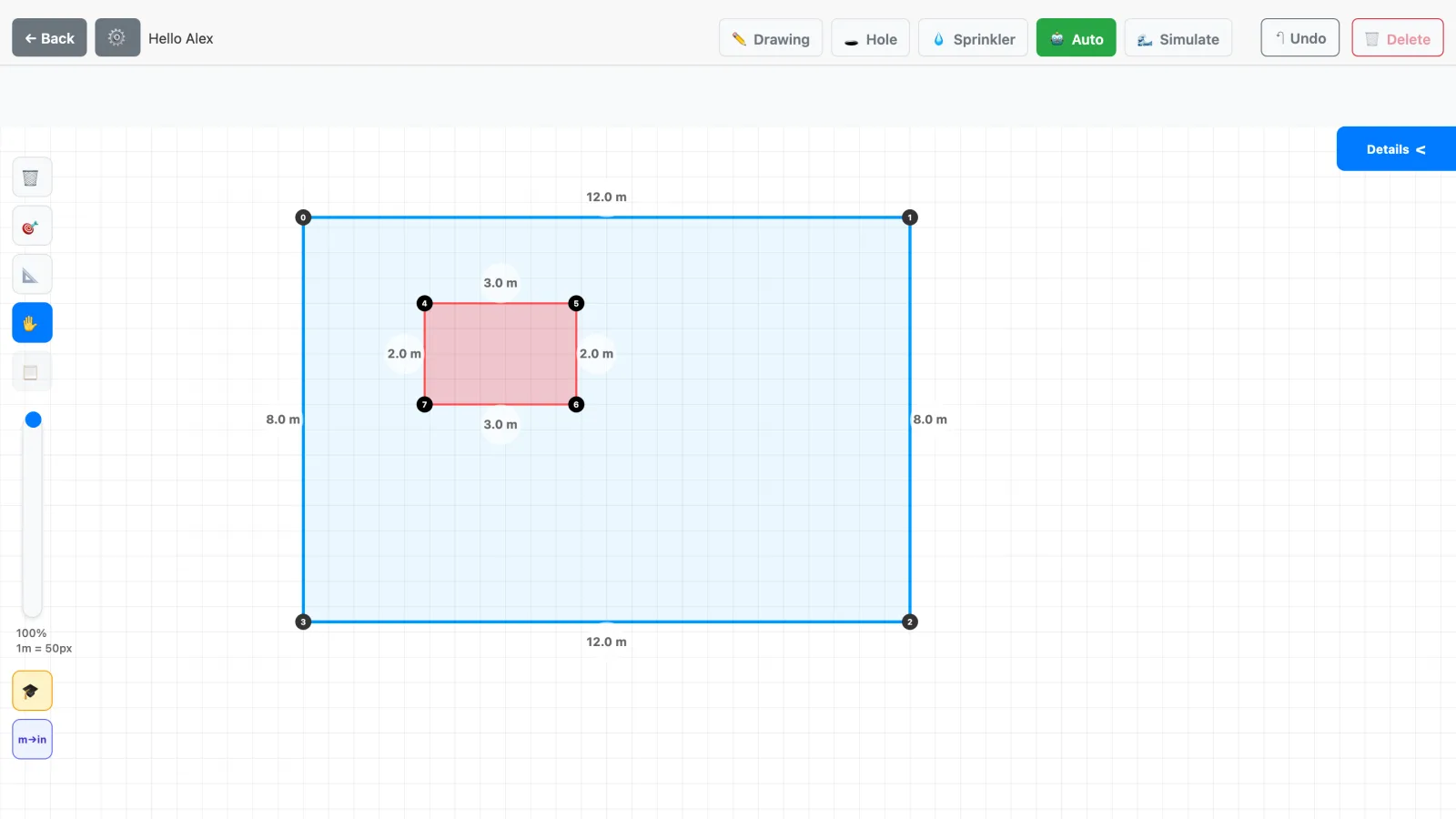
To make everything that follows concrete, this article's example is a project actually drawn in SprinklerMap: a 12 × 8 metre rectangle with a 3 × 2 metre patio, excluded from the calculation with the Hole tool. Irrigable surface: exactly 90 m², measured on the drawing. The patio is the first lesson of hydrozoning, the most trivial and the most ignored: hard surfaces are not a hydrozone, they are a hole in the design — every jet crossing them is water poured onto paving.
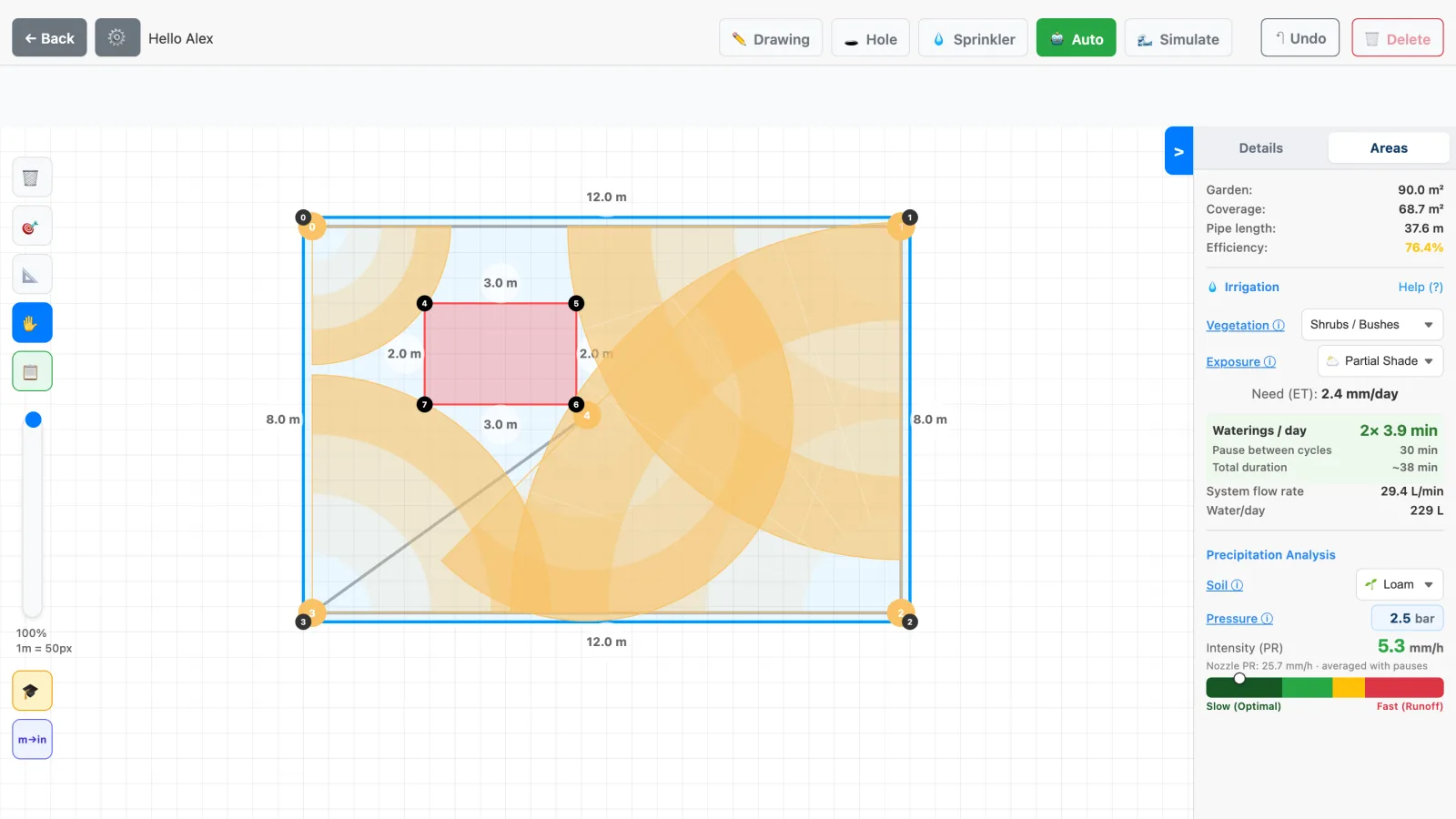
On the real project the app also measures what the eye cannot: 37.6 m of pipe and a system flow of 29.4 L/min with the sprinklers placed automatically — already beyond what a domestic tap delivers, so already worth splitting into at least two hydraulic zones before vegetation even enters the picture. The full path from drawing to parts list, with the same method, is documented in How to design irrigation for a rectangular garden.
The proof in numbers: from 477 to 229 litres by changing only the hydrozone
The Areas panel allows the experiment that is impossible on paper: same geometry, same sprinklers, we change only vegetation and exposure. With lawn in full sun the app calculates a peak need of 5.0 mm per day: 477 litres, delivered in two 8.1-minute cycles with a 30-minute pause (cycle and soak, to stay under the soil's infiltration rate). Set shrubs in partial shade and the need collapses to 2.4 mm: 229 litres, 3.9-minute cycles — less than half the water, on the exact same surface.
This is the hydrozone reduced to one table: if lawn and shrubs shared a single valve with a single schedule, you would either give the lawn the shrubs' regime (dry lawn in July) or the shrubs the lawn's (double the needed water, suffocated roots and fungus). The extra valve separating the two zones costs €15-30; the waste it avoids pays for it within the first season.
| Lawn · full sun | Shrubs · partial shade | |
|---|---|---|
| Water need (ET) | 5.0 mm/day | 2.4 mm/day |
| Calculated schedule | 2 cycles × 8.1 min | 2 cycles × 3.9 min |
| Water per day (summer peak) | 477 L | 229 L |
| Required intensity (PR) | 9.0 mm/h | 5.3 mm/h |
The four typical hydrozones in a home garden
High water use — lawn and vegetable beds. A cool-season lawn needs roughly 1–1.5 inches (25–38 mm) of water per week in midsummer, usually split over 3–4 runs. Vegetables are similar but prefer drip so the leaves stay dry.
Medium use — deciduous shrubs and perennials such as roses and hydrangeas: 2–3 waterings a week in summer, with less volume than turf. Low use — established Mediterranean plants like rosemary, sage and oleander: 1–2 waterings a week at peak summer, often none from fall to spring. Minimal use — succulents and cacti that live on rainfall alone except in extreme drought.
| Hydrozone | Example plants | Summer frequency | Best method |
|---|---|---|---|
| High | Lawn, vegetables | 3–4 / week | Pop-up spray / drip |
| Medium | Roses, hydrangeas, perennials | 2–3 / week | Drip or micro-spray |
| Low | Rosemary, sage, oleander | 1–2 / week | Drip at the roots |
| Minimal | Succulents, cacti | Rarely / never | Hand-water if needed |
How to spot your garden's hydrozones
Start from a sketch of the garden and group plants by thirst. Factor in sun exposure: the same species in full sun uses 30–50% more water than in part shade, so a rose on the north side and one on the south may belong to different schedules.
Soil texture matters too. (Soil texture just means how coarse or fine your dirt is — sand feels gritty, clay feels sticky.) Sandy soil drains fast and wants short, frequent watering; clay holds water and tolerates longer, less frequent runs. If your yard has both, that is another reason to split zones.
In practice, a typical 1,600–3,200 sq ft (150–300 m²) yard with lawn, a mixed bed and a Mediterranean corner needs three hydrozones. A fourth is worth it only if you add a separate vegetable plot or a succulent area.
The hidden limit: your water flow decides zone count
Plant needs are not the only thing that sets the number of zones — the first hard limit is available flow. (Flow is how much water your supply can deliver per minute, measured in gallons per minute, GPM.) If the combined flow of all the heads on one circuit tops 75–80% of your meter's maximum, you must split that circuit, even if the plants match.
Concrete example: with about 3.7 GPM (14 L/min) available and pop-up heads using roughly 0.5 GPM each, a single zone should not exceed 5–6 heads. If the layout needs 10 heads to cover the area, you need at least two zones. Ignore this and pressure sags, throw distance shrinks, and you get permanent dry patches far from each head.
How many zones you actually need: the 2–4 rule
The minimum for a mixed yard (lawn plus beds) is two: one for turf, one for beds. For most homes between roughly 500 and 2,700 sq ft (50–250 m²) of planting, the sweet spot is 3–4 zones: lawn (high), shrubs and perennials (medium), Mediterranean plants (low), and optionally a vegetable plot or pots.
Beyond four zones the extra benefit shrinks fast against the cost of each added circuit — a solenoid valve (the electric valve that opens a zone), wiring, and a controller station. Four well-defined zones capture about 90% of the benefit of a fully optimized system.
Draw them in SprinklerMap
In SprinklerMap you define hydrozones by tracing the outline of each area on a map of your own garden — import the satellite view from Google Maps or draw the perimeter by hand.
Each area gets a watering type (pop-up spray, drip, micro-irrigation) and a plant type. The visual simulation shows each zone's coverage on its own, flagging gaps or heavy overlaps before you buy anything. The materials list at the end breaks valves, pipe and heads down by zone, with quantities taken from your real drawing.
SprinklerMap is not the only free option for this: 7 Best Free Irrigation Design Software Tools (2026) compares it against Orbit, GARDENA and two no-account tools on satellite mapping, automatic placement and materials lists.
Common hydrozone mistakes to avoid
Mixing spray and drip on the same valve. Pop-up spray and drip run at different pressures and apply water at very different rates, so a shared circuit overwaters one half of the landscape and starves the other. Keep them on separate zones even when the plants are similar.
Putting sun and shade on one zone. The same shrub bakes in full afternoon sun and coasts in shade, yet a single schedule treats them alike. If one bed spans both, either split it or set the run time for the sunniest part and hand-water the rest.
Forgetting that new plantings are their own hydrozone. For the first season or two, young trees and shrubs need more frequent, shallower water than the established plants around them. A temporary drip line on its own valve avoids drowning the mature plants while the new roots settle in.
Frequently asked questions
How much water can correct hydrozoning actually save?
On a real 90 m² SprinklerMap project, giving shrubs in partial shade their own schedule instead of sharing the lawn's cut the calculated daily need from 477 to 229 litres — 52%, on the exact same surface, changing only the hydrozone.
What decides how many zones I actually need, plants or water flow?
Both, but flow is the hard limit. If the combined flow of all heads on one circuit tops 75-80% of your meter's maximum, you must split that circuit even if the plants would otherwise share a zone happily.
How many hydrozones does a typical home garden need?
Two is the minimum for a mixed yard (lawn plus beds). For most homes with 50-250 m² of planting, the sweet spot is 3-4 zones: lawn, shrubs and perennials, Mediterranean plants, and optionally a vegetable plot. Beyond four, the extra benefit shrinks fast against the cost of each added valve.
What is the most commonly overlooked hydrozone?
Newly planted trees and shrubs. For the first season or two they need more frequent, shallower watering than the established plants around them — a temporary drip line on its own valve avoids drowning the mature plants while new roots settle in.
Recommended products
These product links are affiliate links: if you buy on Amazon or AliExpress through them it costs you nothing extra, but it helps us keep SprinklerMap alive as a project and create new useful content.
These products are catalogued in our brand database, with the same description and price range you find on the manufacturer page.

| Model | Type | Description | Radius (m) | Price (€) | Buy |
|---|---|---|---|---|---|
| 🖥️ X-Core (4-8 zone) | Controller | Outdoor controller with weatherproof enclosure, 4-8 zones, 3 independent programs. The industry standard for residential installations. | — | €90-210 | Amazon |

| Model | Type | Description | Radius (m) | Price (€) | Buy |
|---|---|---|---|---|---|
| 🔧 DV100 | Valve | Entry-level 1" residential solenoid valve. Reliable and compatible with all standard controllers. | — | €28-55 | Amazon |
Other suggested products
Products not in the brand catalogue: generic material, tools and accessories where the right size matters more than the brand.
| Product | Description | Price (€) | Buy |
|---|---|---|---|
| Wireless soil moisture probe | Wireless volumetric soil moisture sensor, 0-100% range, 433 MHz transmission. Push it into the ground near the plants and it sends data to the receiver. Compatible with most smart controllers. | ~€20-50 | Amazon |
| Rain Bird DV 1" solenoid valve | Rain Bird DV 24V AC solenoid valve, 1 inch. Flow 0.7-45 L/min, pressure 1.4-10 bar. The residential standard: robust, easy to service, spares available everywhere. | ~€20-40 | Amazon |
| 2-core irrigation valve cable, 100 m | Underground UF two-core cable rated for direct burial, 100 m. 1 mm² copper conductors for 24V AC valves up to 150 m from the controller with no voltage drop. | ~€25-50 | Amazon |
| Product | Description | Price (€) | Buy |
|---|---|---|---|
| Irrigation solenoid valve 3/4"-1", 24V AC | Solenoid valve compatible with standard 24V controllers. Good as a spare: check the thread and whether flow control is included. | ~€8-20 | AliExpress |
| Zigbee/WiFi soil moisture sensor | Wireless in-ground probe reporting soil moisture and temperature in-app. With Home Assistant or Zigbee2MQTT it becomes the trigger to skip pointless cycles. | ~€8-20 | AliExpress |
Technical note: The pressure, flow, coverage radius and cost figures in this article are indicative and calculated under standard conditions (2.5 bar, flat ground, short pipe runs). The actual outcome depends on the pressure available in your system, your meter's flow rate, head loss along the pipes and the specifications of the sprinklers you choose. For larger installations or complex situations, it's worth checking with a qualified technician or running the numbers on your own garden's real data.