How to choose sprinkler nozzles for uniform lawns
Nozzle choice drives real distribution quality. Pick radius, arc and precipitation compatibility carefully.

Sprinkler body vs nozzle: not the same thing
The pop-up body is the mechanical riser that comes up out of the ground; the nozzle screwed onto the top is the part that decides how the water is spread — radius, spray angle, flow rate and the distribution pattern. Swapping the nozzle can completely change how a head performs without replacing the body underneath.
Many coverage problems start with this confusion: people assume a hardware failure and replace the whole pop-up when a slightly different nozzle, or just cleaning limescale off the old one, would fix it. The major brands (Rain Bird, Hunter, Toro, Gardena) sell nozzles separately for $1–3 each.
The MPR rule (matched precipitation rate)
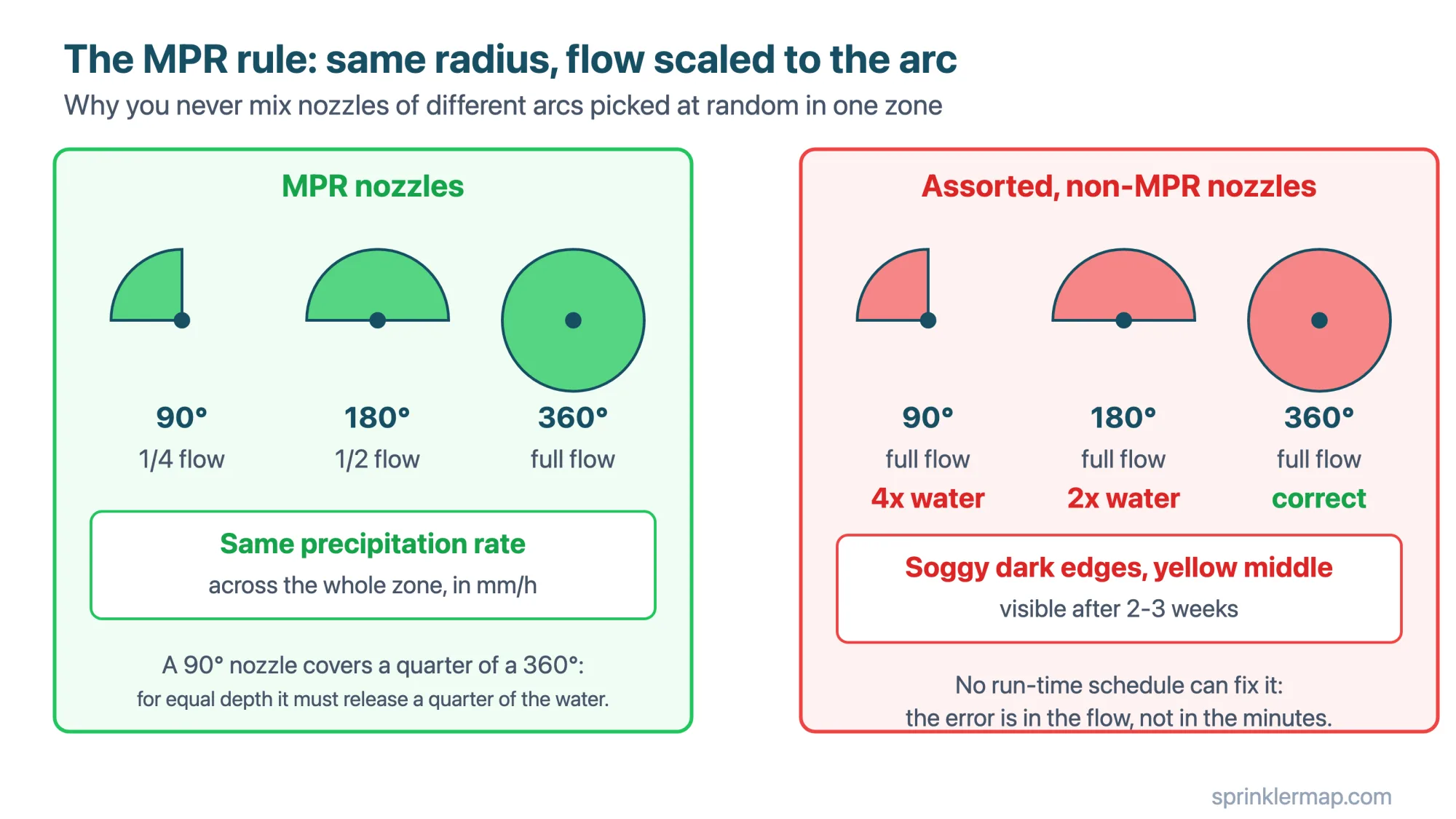
MPR means every nozzle in a zone lays down the same depth of water per hour, regardless of its arc. (Precipitation rate is just how fast a sprinkler applies water, in inches or mm per hour — think of it as rainfall intensity.) A 90° nozzle covers a quarter of the area of a 360° one, so it must release a quarter of the flow to apply the same depth.
Mix ordinary nozzles of different arcs and some areas get twice the water of others, even with perfect geometry. You see it after 2–3 weeks: dark, soggy strips at the edges and yellow patches in the middle. Nozzles sold as MPR are pre-matched so the depth stays even across the whole zone.
Real radius, arc and working pressure
The catalog radius is measured at the nozzle's ideal pressure (usually 30–36 PSI / 2–2.5 bar) with zero wind. In the field the radius shrinks with pressure: at 22 PSI (1.5 bar) a nozzle rated for 13 ft (4 m) may reach only 9–10 ft (2.8–3 m).
Too much pressure — over 45–50 PSI (3–3.5 bar) — and the stream mists: droplets get so fine the wind carries them off the lawn. Fit pressure-regulated (PR) nozzles or heads if your static pressure tops 50 PSI.
Fixed spray vs rotary nozzles: which to pick
Fixed spray nozzles throw a continuous fan of water. Radius 5–16 ft (1.5–5 m), high precipitation rate (0.8–1.6 in/hr / 20–40 mm/hr). Good for small, compact lawns, but on clay soil that high rate can cause runoff — water sliding off before it can soak in.
Rotary nozzles (Hunter MP Rotator, Rain Bird R-VAN) send out several thin streams that rotate slowly. Radius 6–30 ft (2–10 m), low precipitation rate (0.3–0.5 in/hr / 8–12 mm/hr). Ideal for clay soil, slopes and windy spots. The low rate means longer run times but far less runoff.
| Nozzle type | Radius | Precipitation rate | Best for |
|---|---|---|---|
| Fixed spray | 5–16 ft (1.5–5 m) | 0.8–1.6 in/hr (high) | Small, compact lawns |
| Rotary (MP Rotator / R-VAN) | 6–30 ft (2–10 m) | 0.3–0.5 in/hr (low) | Clay, slopes, wind |
| Rotor | 23–40 ft (7–12 m) | 0.2–0.4 in/hr (low) | Large lawns |
Practical sizing by lawn size
Small lawns up to about 540 sq ft (50 m²): fixed spray nozzles 6–10 ft (2–3 m). Medium lawns 540–1,600 sq ft (50–150 m²): sprays 10–15 ft (3–4.5 m) or MP Rotator rotary nozzles 13–20 ft (4–6 m). Large lawns over 1,600 sq ft (150 m²): rotors with 23–40 ft (7–12 m) radius, or sprays around the perimeter and rotary nozzles inside.
In windy areas always prefer rotary nozzles or low-trajectory sprays: they cut in-flight evaporation and hold their rated radius even in a light breeze.
Nozzle maintenance: when and how
Nozzles clog with calcium, sand and organic debris. The clearest warning sign is a shorter throw on one single head: unscrew the nozzle, soak it in white vinegar for 30 minutes, then clear the openings with a thin needle.
Always replace a dead nozzle with the same model and series. Swapping just one nozzle out of four for a different series breaks the zone's MPR and forces you to recalibrate the whole watering schedule.
Common nozzle mistakes
Going up a nozzle size just to "reach a little farther" without checking flow. Each larger nozzle uses more gallons per minute, and a few of them together can push the zone past your available flow, collapsing pressure for every head on the circuit. Add reach by adjusting spacing or pressure first, not by oversizing nozzles.
Mixing brands or series in one zone. Even two MPR nozzles from different makers can apply slightly different depths, so stick to one family per zone and the matched-rate math actually holds.
Ignoring trajectory in wind. A standard spray throws a high arc that the wind shreds into mist. Low-angle nozzles keep the stream closer to the ground and hold their pattern in a breeze — a small spec on the box that makes a big difference outdoors.
Frequently asked questions
How do I know which nozzle is on my head?
Most brands stamp the radius and arc on the top of the nozzle and color-code them by series. If it is worn off, a $2 replacement of the right size beats guessing.
Can I make a sprinkler cover less area?
Yes — many nozzles have an adjustable arc, and you can step down to a smaller fixed nozzle. What you should not do is leave the head's flow screw half-closed, since that distorts the pattern and wastes pressure.
What is the best nozzle brand for professional results?
Rain Bird, Hunter, and Toro are the professional benchmarks — their nozzle portfolios cover every arc, radius, and precipitation rate with matched-rate precision across the full range.
Recommended products
These product links are affiliate links: if you buy on Amazon or AliExpress through them it costs you nothing extra, but it helps us keep SprinklerMap alive as a project and create new useful content.
These products are catalogued in our brand database, with the same description and price range you find on the manufacturer page.

| Model | Type | Description | Radius (m) | Price (€) | Buy |
|---|---|---|---|---|---|
| 💧 MP Rotator MP3000 | Pop-up | Rotating low-flow nozzle for water savings of up to 30%. Fits any standard ½" pop-up. | 5.5–9.1 m | €8-14 | Amazon |
Other suggested products
Products not in the brand catalogue: generic material, tools and accessories where the right size matters more than the brand.
| Product | Description | Price (€) | Buy |
|---|---|---|---|
| Rain Bird MPR assorted nozzles (10' and 12') | Assorted kit of Rain Bird MPR nozzles in 10' (3 m) and 12' (3.7 m) sizes, 90°-360° arcs. Flow calibrated to keep matched precipitation across the zone. Compatible with Rain Bird 1800 bodies and other 1/2" female-thread bodies. | ~€22-38 | Amazon |
| Hunter MP Rotator MP2000 and MP3000 (set) | Set of Hunter MP Rotator rotating nozzles: MP2000 (4.0-6.4 m / 13-21 ft radius) and MP3000 (6.7-9.1 m radius), adjustable 90°-210° and 210°-270° arcs. Low 8-10 mm/h precipitation rate. Need at least 2.8 bar. | ~€35-70 | Amazon |
| Rain Bird R-VAN rotary nozzles (assorted kit) | Rain Bird R-VAN rotary nozzles, Rain Bird's own alternative to the MP Rotator. 3-8 m radius with adjustable arc. Ideal for clay soils and slopes, compatible with Rain Bird 1800 bodies. | ~€28-55 | Amazon |
| Universal wrench for nozzles and pop-up bodies | Two-pin tool for removing and fitting nozzles without damaging the deflector. Compatible with all the main brands (Rain Bird, Hunter, Toro). | ~€8-15 | Amazon |
| White vinegar 5% for nozzle maintenance (5 L) | Food-grade white vinegar at 5% acetic acidity, ideal for soaking nozzles clogged with limescale. Non-toxic and harmless to the nozzle plastic. | ~€5-10 | Amazon |
| Product | Description | Price (€) | Buy |
|---|---|---|---|
| Assorted spray nozzles for pop-ups | Nozzle set with different arcs and radii on the standard thread: lets you fix coverage without replacing the sprinkler bodies. | ~€8-20 | AliExpress |
| Pop-up spray heads 4" (set) | Set of 10 cm pop-ups with adjustable nozzles and the standard 1/2" thread: handy as spares or to finish secondary zones. | ~€12-30 | AliExpress |
Technical note: The specs, coverage radii and price ranges quoted in this article are based on manufacturer datasheets and public catalogues. None of the models mentioned was tested directly: the comparison is on the specifications declared by the manufacturers. Figures can vary between models and after a product line is updated. Before buying, always check the current datasheet of the specific product you're considering, since stated performance changes with the actual operating pressure of your system.