Smart garden: how to design an intelligent irrigation system
Complete guide to building a smart irrigation system: WiFi controllers, smart valves, rain sensors and soil moisture sensors. Zigbee and WiFi protocols, Tuya and Home Assistant integration.

What a smart garden is and what you gain
A smart irrigation system is not just a fancier timer: it collects data from the environment (weather, soil moisture, temperature) and automatically adapts watering to real conditions. The result is 20–40% water savings versus fixed-schedule timers, with a healthier garden because it is never under- or over-watered. For a water-saving overview see How to cut lawn irrigation water use: the gallons, the bill, and which change saves the most.
The practical difference: a classic timer waters Tuesday and Friday regardless of rain. A smart system skips Tuesday because the soil moisture sensor detected the ground is still saturated, and resumes Thursday only if the weather forecast shows no rain. These decisions happen automatically.
The architecture: where each sensor fits in the design's logic
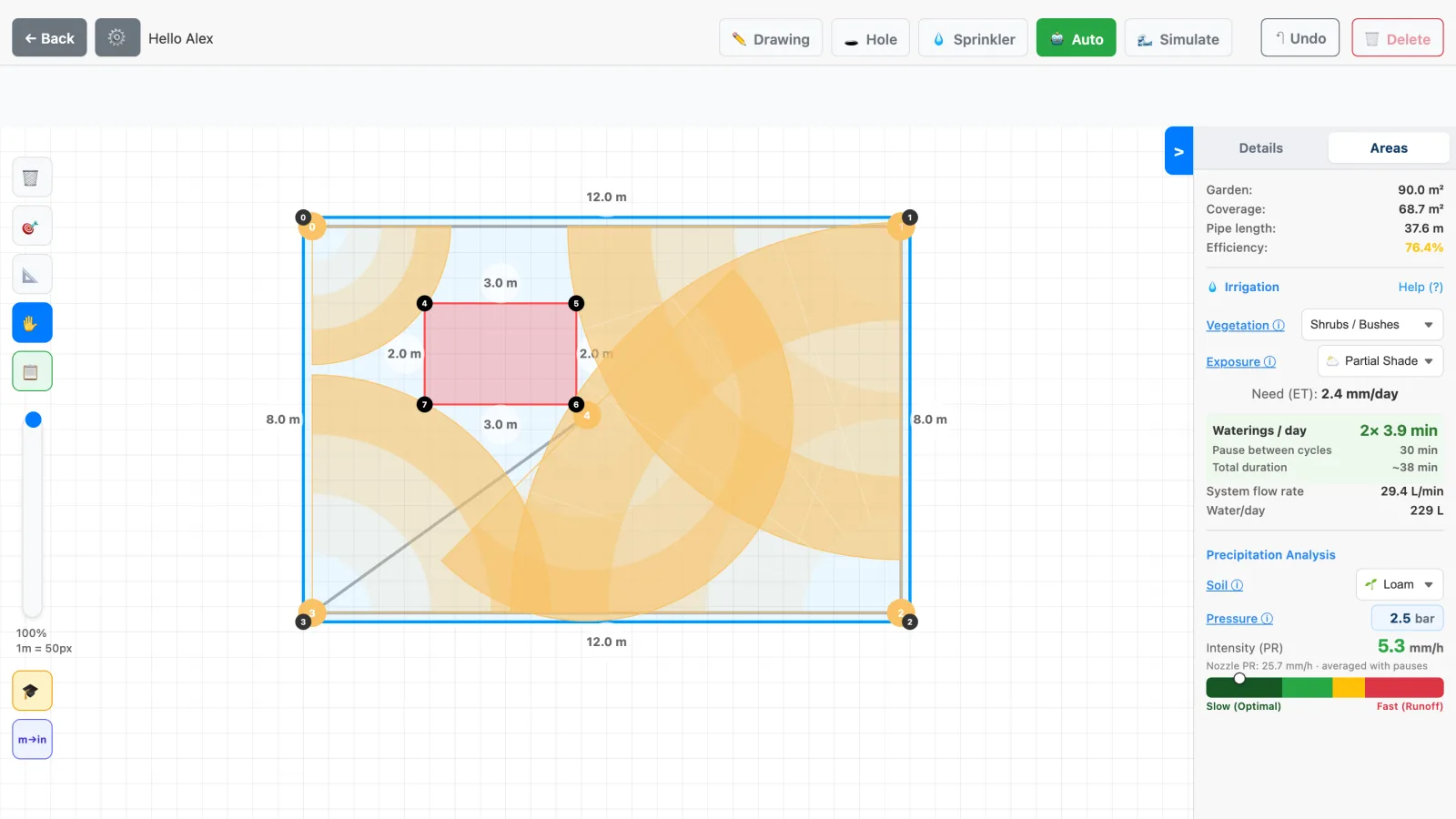
Before choosing a single product, you need the architecture. A smart garden has three layers: the design (the static per-zone need, calculated from the drawing: on the real project below the same surface asks for 477 litres a day as full-sun lawn and 229 as partial-shade shrubs), the schedule (the controller running different cycles per zone), and the sensors, which correct live what the static calculation cannot know: the rain sensor cancels pointless sessions, the moisture sensor verifies the water actually arrived where it was needed, weather data rescales the need as the season moves.
Read this way, the choice stops being a catalogue and becomes three questions. Away for long stretches in summer? The moisture sensor is the only one that notices a broken sprinkler while you are gone. Zones with very different vegetation? First you need separate zones (Hydrozones: split your garden to irrigate better), then per-zone sensors. Just want a smaller bill? The €30-50 rain sensor is the first purchase and pays for everything else. Every device in the sections below should be judged on one thing only: which error of the static calculation it corrects, and at what price.
System architecture: how the pieces connect
The system has four layers. Sensors (rain, soil moisture, temperature) gather environmental data. The central controller or hub receives and processes sensor data. Solenoid valves open and close water for each zone on command. The phone app shows real-time status.
In its simplest form, all four layers are integrated into a single WiFi controller such as Orbit B-hyve or Rachio 3: buy one device, connect to home WiFi, install the app and you are operational in 30 minutes. The advanced version uses Home Assistant, which talks to any device and gives full customisation freedom.
WiFi vs Zigbee: which protocol to choose
WiFi devices connect directly to your home router: instant setup, no additional hub, but each device uses an IP address and consumes more power. Great for controllers and main valves where you have mains power anyway.
Zigbee is a low-power protocol designed for battery-operated sensors: a Zigbee soil moisture sensor runs for 2 years on a single AA battery. The catch is that it requires a coordinator (a USB dongle connected to a hub). If you already run Home Assistant, adding Zigbee garden sensors costs very little.
Controllers and smart valves
The controller is the brain of the system. Mid-range WiFi models (Orbit B-hyve, Hunter Hydrawise, Rachio 3) cost €60–150 and manage 6–16 zones. They update over-the-air, pull cloud weather forecasts and have polished apps. For existing systems they are direct replacements for the old analogue programmer — see Smart sprinkler controllers: what WaterSense and Wi-Fi actually save, rebates, and when the upgrade pays.
Smart WiFi solenoid valves are an alternative when you want to make only certain zones smart without replacing the central programmer. They connect directly to the outdoor tap or supply line and are controlled by app.
Sensors to install
Wireless rain sensor: mandatory in any smart system. Mounted on a roof edge or post, it connects wirelessly to the controller and automatically suspends all cycles during rain. Entry-level models cost €20–40.
Soil moisture sensor: goes into the ground at 10–15 cm depth and measures volumetric water content. It does not just skip watering while it is raining (the rain sensor already does that) but also skips watering when the soil is still wet from rain three days ago. Zigbee models have excellent battery life and integrate natively with Home Assistant.
Wired vs wireless soil sensors, and how to install them
Wireless soil moisture sensors (like the Ecowitt WH51 or Zigbee models) go 10-15 cm into the ground and transmit the reading by radio to the gateway or controller. Installation is simple: push the probe into the soil vertically, connect the batteries, done. Typical battery life is 12-24 months on 2 AA cells. The weak point is wireless reliability in gardens with lots of obstacles — walls, tall hedges, metal structures — so always test signal strength before relying on the probe for automations.
Wired sensors (such as the Davis Instruments range or professional Decagon probes) are more accurate and have no connectivity issues, but need a cable run back to the controller — practical only if the sensor sits close to the hub. For home gardens, Zigbee or 433 MHz wireless models are the right trade-off. Always install at least 2 sensors in different spots: a single measurement point never represents the whole garden.
How sensors physically connect to the controller
Smart controllers accept sensors in two physical ways: a wired input with two terminals (usually labelled SENS or RAIN, for traditional normally-closed contact rain sensors) or via radio/cloud, where the wireless sensor talks to a proprietary gateway that in turn talks to the controller over WiFi. Most mid-range controllers accept both at once — a wired rain sensor plus wireless soil moisture sensors.
Once a sensor is physically connected, the next step is writing the rules that decide when to skip a cycle or shorten it: moisture thresholds, rain skip, frost protection. That part — with Home Assistant and Tuya automation examples — is covered in detail at Irrigation automations: schedules, weather and sensors in practice.
Integrating a weather station: Davis, Netatmo and Ecowitt
A personal weather station in your own garden is worth more than any commercial weather API: it measures rainfall exactly where your plants are, not at the nearest airport. Ecowitt stations (GW2000 gateway plus sensors) offer the best value for home use and integrate natively with Home Assistant through the local Ecowitt protocol.
Netatmo is the choice for anyone who wants the simplest setup and a polished app. It lacks deep integrations with professional irrigation controllers, but supports IFTTT, which lets it drive many smart controllers indirectly. Davis Instruments (Vantage Pro, Vue) is the professional-grade choice used by nurseries: superior accuracy, but at a price (€200-800) that only makes sense for large gardens or anyone who wants high-quality data for ET calculations.
With Ecowitt plus Home Assistant you can build a complete logic chain: the rain gauge measures millimetres fallen in the last 48 hours, the soil sensor measures current ground condition, and Open-Meteo forecasts add the outlook for the next 24 hours. The controller combines all three inputs and decides on its own whether to irrigate, and for how long.
What the sensor layer actually costs (separate from the controller)
On top of the controller cost (covered in Smart sprinkler controllers: what WaterSense and Wi-Fi actually save, rebates, and when the upgrade pays), the sensor layer adds: a wireless rain sensor (€20-40), 2 Ecowitt or Zigbee soil moisture sensors (€40-60 total), an Ecowitt gateway or Zigbee coordinator (€25-50), cables and adapters (€15-25). Total sensor layer for a 200 m² garden with 4 zones: roughly €100-175. A complete personal weather station (Ecowitt GW2000 kit) replaces the rain sensor plus gateway with a single €60-100 device and adds temperature, wind and solar radiation data.
A Raspberry Pi 5 running Home Assistant is optional (€60-90) and only needed if you want to write your own rules instead of relying on the controller's pre-built cloud logic. With a documented 25-40% water saving from sensors alone (independent of which controller you choose), the sensor-layer investment typically pays for itself within 2-4 seasons on an average summer water bill.
First-year sensor calibration mistakes
The most common problem with a freshly installed smart garden is not the automation logic — it is calibration. The initial parameters (soil type, probe burial depth, moisture threshold) are entered by the user and often do not match reality. A probe buried too shallow (under 8 cm) reads surface moisture, which dries out much faster than the root zone — the result is a system that waters more than it needs to.
During the first year, check the lawn one morning a week before the sun dries the dew: if the soil at 5 cm is dry and the grass shows rolled leaves despite the sensor reporting adequate moisture, the sensor is probably mis-positioned or poorly calibrated. Always install at least 2 sensors in different spots — a single measurement point never represents the whole garden, especially on plots with mixed sun exposure.
Apps and integrations: Tuya Smart Life and Home Assistant
Most smart garden devices on the market run on the Tuya ecosystem: devices appear in the Smart Life app, support basic automations and integrate with Alexa and Google Home. Best choice if you have no technical background — everything works out of the box.
Home Assistant is the self-hosted platform that integrates any device — Tuya, Zigbee, Z-Wave, WiFi. It gives unlimited automations, local historical data and no cloud dependency. Specific automations (rain skip via weather API, moisture thresholds, frost protection) are covered in detail in Irrigation automations: schedules, weather and sensors in practice.
Key takeaways
A smart garden system works in layers: sensors gather real data, a controller interprets it, valves act on commands, and an app shows status at a glance. For most users, a single WiFi controller like Orbit B-hyve or Rachio 3 covers all four layers with minimal setup. Tuya Smart Life is the right ecosystem for beginners; Home Assistant is the right choice for anyone who wants local control, unlimited device compatibility, and advanced automations. Add a soil moisture sensor after the controller — it is the single upgrade that most reduces over-watering.
Frequently asked questions
Can I retrofit a smart controller onto an existing traditional system?
Yes. Smart controllers like Rachio 3 and Hunter Hydrawise are direct replacements for any 24V AC multi-zone controller. They connect to the same valve wiring. The only addition needed is a WiFi connection near the installation point.
Do I need both a rain sensor and a soil moisture sensor?
They measure different things and complement each other. The rain sensor responds immediately to active rainfall. The soil moisture sensor prevents irrigation when the ground is still wet from previous rain — even three days later. For a complete system, both are worth having.
What is the minimum smart setup on a tight budget?
A Tuya 4-zone WiFi controller (€25–45) plus a wireless rain sensor (€20–35). This combination covers the two most impactful automations — scheduled programmes and rain skip — for under €80 total.
Recommended products
These product links are affiliate links: if you buy on Amazon or AliExpress through them it costs you nothing extra, but it helps us keep SprinklerMap alive as a project and create new useful content.
These products are catalogued in our brand database, with the same description and price range you find on the manufacturer page.

| Model | Type | Description | Radius (m) | Price (€) | Buy |
|---|---|---|---|---|---|
| 📡 WH51 | Sensor | Wireless soil moisture sensor. Transmits every 16 s, 20 cm depth, range −40 °C/+60 °C. Integrates with Ecowitt gateway and Home Assistant. | — | €20-35 | AmazonAliExpress |

| Model | Type | Description | Radius (m) | Price (€) | Buy |
|---|---|---|---|---|---|
| 📡 Soil Moisture Sensor (1867) | Sensor | Bluetooth soil moisture sensor for the Gardena Smart ecosystem. Prevents unnecessary watering on damp soil. | — | €30-50 | Amazon |
| 📡 Sensore meteo 1189 | Sensor | Rain gauge integrated into the Gardena ecosystem. Automatically suspends irrigation when it rains. | — | €30-50 | Amazon |

| Model | Type | Description | Radius (m) | Price (€) | Buy |
|---|---|---|---|---|---|
| 📡 Rain-Clik | Sensor | Rain sensor with adjustable threshold (3–25 mm). The wired version stays the cheapest; the wireless kit with receiver costs around three times as much. Compatible with all Hunter controllers. | — | €55-160 | Amazon |
Other suggested products
Products not in the brand catalogue: generic material, tools and accessories where the right size matters more than the brand.
| Product | Description | Price (€) | Buy |
|---|---|---|---|
| Orbit B-hyve XR 8-zone WiFi controller | Smart controller for 8 zones with built-in WiFi, automatic rain skip via weather API, compatible with Alexa and Google Home. | ~€70-110 | Amazon |
| Hunter wireless rain sensor | Wireless rain sensor with receiver for connecting to the controller. Automatically suspends irrigation during and after rain. | ~€25-45 | Amazon |
| Sonoff Zigbee Bridge Pro | Zigbee 3.0 gateway compatible with Home Assistant via Zigbee2MQTT. Handles up to 128 Zigbee devices. USB-powered, no cloud subscription. | ~€18-28 | Amazon |
| Product | Description | Price (€) | Buy |
|---|---|---|---|
| 4-zone WiFi irrigation controller (Tuya) | Smart 4-zone WiFi controller compatible with Smart Life, Alexa and Google Home. Weekly scheduling, automatic rain skip, native Tuya integration. Great budget alternative to US brands. | ~€25-45 | AliExpress |
| Zigbee soil moisture sensor | Zigbee volumetric soil moisture probe with percentage output. Installs 10–15 cm deep and measures actual soil water content. 1–2 year battery life, Home Assistant compatible. | ~€12-22 | AliExpress |
Technical note: The compatibility of the smart devices mentioned in this article (WiFi/Zigbee protocol, app, power supply) can change with manufacturer firmware updates and isn't guaranteed with every existing valve or controller. Before buying, always check compatibility with your current system and your home network on the manufacturer's website. None of the models mentioned was tested directly: the comparison is on the specifications declared by the manufacturers.