Irrigation automations: schedules, weather and sensors in practice
How to set up intelligent irrigation automations: rain skip, soil moisture thresholds, frost protection and seasonal adjustment. Practical examples with Tuya Smart Life and Home Assistant.

Fixed timer vs real automation: what is the difference
A fixed timer runs the same programme regardless of rain, saturated soil or temperature. A real automation responds to the environment — it is not just about convenience: a system that waters in the rain wastes water and can cause root rot. For choosing the right controller see Smart garden: how to design an intelligent irrigation system.
The automations covered here work on three levels: weather (forecasts and rain sensors), soil (moisture sensors) and seasonality (automatic winter reduction). Each intercepts a different type of waste and together they cover virtually every real-world scenario.
The scenario to automate: the schedule comes from the design
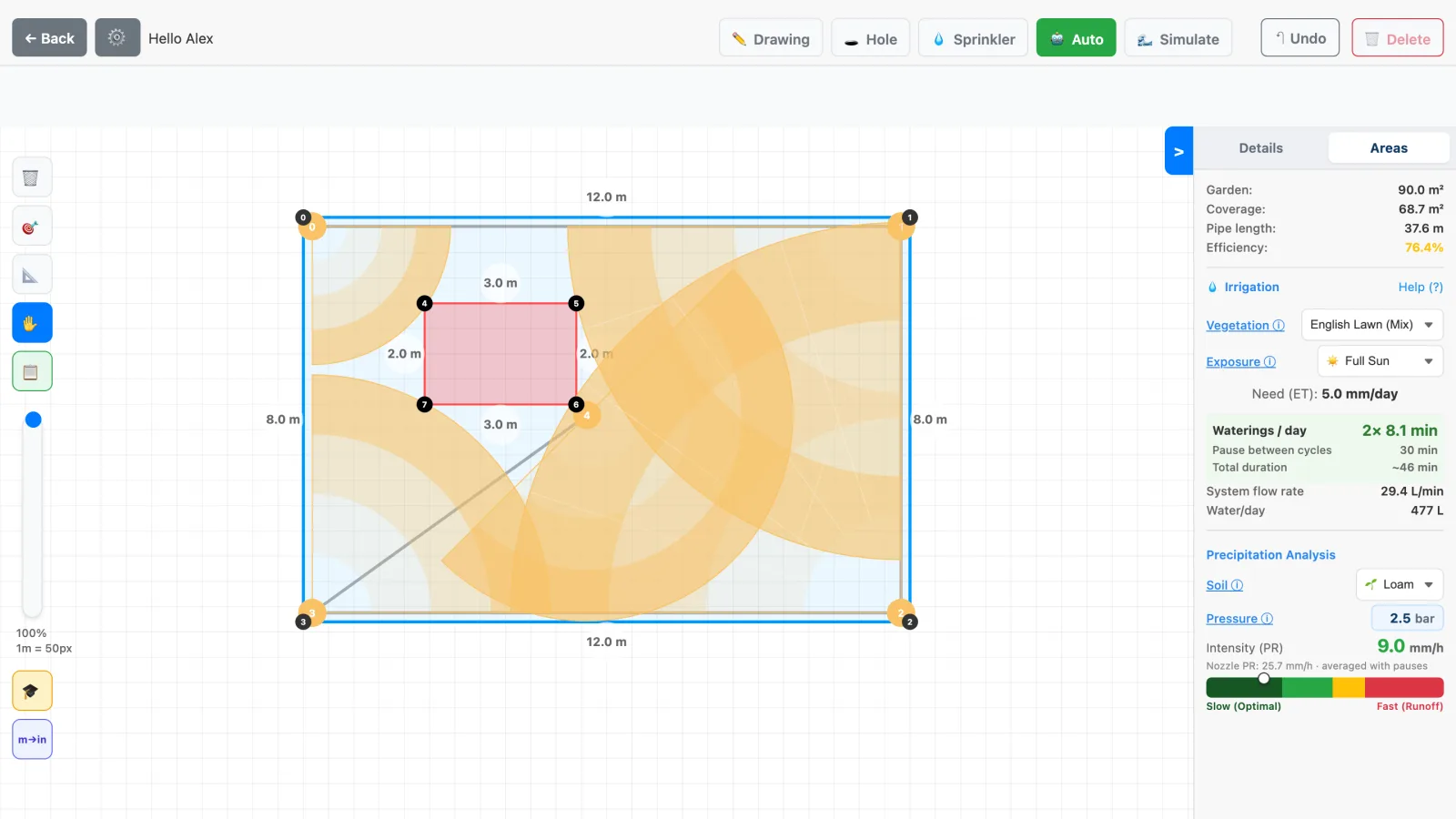
Before talking scenes and triggers, you need the thing almost every automation guide skips: a correct base schedule to automate. The controller does not invent it, the design calculates it: on the real 90 m² garden below, SprinklerMap derives a peak need of 5.0 mm/day from the drawing and vegetation, and turns it into 2 cycles of 8.1 minutes with a 30-minute pause (cycle and soak, to stay under the soil's infiltration rate) and 477 litres. Smart automation does not decide how much to water: it executes this program and corrects it when the real world asks.
The full scenario, with the project's numbers: start at 5:30, second cycle at 6:10 after the pause; the rain sensor skips the whole session if it has rained; the soil moisture sensor confirms or brings it forward against its threshold; weather data rescales the minutes with the real need (June's ET is not August's). Every automation in this article should be read this way: a corrector wrapped around a calculated schedule. If the base program is wrong, automation just automates the waste — the calculation for your garden is in How long to run sprinklers: minutes per cycle by soil and head type, with the math behind them and zone splitting in Hydrozones: split your garden to irrigate better.
Basic automations: schedules and weekly programmes
Start with a schedule: set days of the week, start time and duration per zone. Always start before dawn (5:00–6:00) to reduce evaporation and have the lawn dry during use hours. Avoid evening irrigation that leaves the lawn wet overnight, encouraging fungal disease.
In Tuya Smart Life, programmes are set in the app under Scheduling. You can create multiple programmes per zone (e.g. a summer and an autumn schedule) and switch manually by season. For traditional timer and programmer setup see Irrigation controllers and timers: how to choose the right model.
Rain skip: physical sensor vs weather API
A physical rain sensor blocks irrigation during active rain. It works locally without internet and responds instantly. The limitation is that it reactivates as soon as rain stops, even if the soil is still saturated.
Weather API integration is more sophisticated: the controller checks forecasts hourly and skips the cycle if rain is expected in the next 6–12 hours. Orbit B-hyve and Rachio 3 do this natively. On Home Assistant you can use Open-Meteo integration (free, no API key) and write: IF rain_forecast_6h > 5mm THEN skip_morning_cycle.
Automations based on soil moisture sensors
The soil moisture sensor is the most valuable data point for smart irrigation. A typical operating threshold: water if volumetric moisture drops below 35%, hold if it exceeds 60%. These values vary by soil type and plant — a sandy lawn needs more frequent watering than a clay one. For how soil type affects timing see How long to run sprinklers: minutes per cycle by soil and head type, with the math behind them.
On Home Assistant: IF soil_moisture < 35% AND time > 05:00 AND time < 07:00 THEN open_valve_zone_1 FOR 15 minutes. On Tuya Smart Life, conditional automations based on sensors require Tuya-certified devices — always check compatibility before buying.
Frost protection and seasonal adjustment
Frost protection is a critical automation: if temperature drops below 3°C, block all cycles and do not restart until it rises above 5°C. Water freezing in pipes can crack fittings and sprinkler bodies. With an outdoor temperature sensor (under €20) you can create this automation on any smart platform.
Seasonal adjustment automatically reduces cycle duration as a percentage by month: July at 100%, September at 70%, October at 40%. Orbit B-hyve and Rachio 3 calculate it automatically based on estimated evapotranspiration. On Home Assistant it is implemented with a numeric helper that scales cycle duration according to a configurable calendar.
Evapotranspiration: what it is and how apps use it to save water
Evapotranspiration (ET) is the sum of water lost from the soil surface and water released by plants. It is the number that actually tells you how much water your garden lost in the last 24 hours. Smart controllers such as Rachio 3, Hunter Hydrawise and Orbit B-hyve pull local weather data — temperature, relative humidity, wind speed, solar radiation — and calculate daily ET using the Penman-Monteith formula.
In practice: a July day at 33°C with 20 km/h wind produces an ET of 6-8 mm. The controller compares that figure against how much you have already watered in recent days and decides whether that morning's cycle is actually needed. In Mediterranean climates the documented saving versus a fixed schedule is 25-40% over the summer season.
Reference evapotranspiration (ET0) is published free by most national meteorological services. Search for "reference ET0 July [your region]": you will find daily values from 4 to 9 mm depending on climate. That figure is the ceiling on how much water your garden can realistically lose per day in peak summer.
Connecting to Google Home and Alexa: the practical steps
Linking a Tuya or Orbit B-hyve controller to Google Home takes under 5 minutes: open Google Home, tap "+", choose "Set up device", then "Works with Google", search for "Smart Life" or your controller's brand, enter your account credentials, and Google imports every linked device automatically. From then on you can say "Hey Google, start zone 1 for 10 minutes."
The Alexa process is similar: find your brand's skill in the Alexa Store, enable it and link the account. You can build Alexa routines such as: when the temperature exceeds 30°C, start the lawn zone for 15 minutes at 6 am. It is not full ET-based automation, but it already beats a fixed timer by a wide margin.
One caveat: both Google Home and Alexa run through the cloud, so they need an active internet connection. For systems where continuity matters, Home Assistant on a Raspberry Pi running fully locally is the safer choice.
Real-world case: how much you actually save
A 200 m² garden with lawn and beds on a fixed summer schedule typically uses 600-800 litres a week. With rain skip and a soil moisture sensor active, consumption drops to 350-500 litres — a 35-40% reduction. At average European water prices (roughly €1.5-2/m³) that is €10-15 saved per summer month.
The litre saving carries environmental weight too: a smart 200 m² garden uses roughly 4-6 m³ less water per season than one on a fixed timer. With water becoming a genuinely scarce resource in many European summers, that number matters beyond the household bill.
Limits of weather automations and how to manage them
Cloud-based weather automations have one structural limit: latency. The controller checks forecasts every 1-6 hours, so a rain skip can trigger 2-3 hours after rain has already started. The right approach is to combine a physical sensor with the weather API: the physical sensor blocks irrigation in real time, the API prevents future cycles.
A second issue: weather APIs use the nearest official station, not the one in your actual garden. If you live somewhere with a distinct microclimate — near a lake, in a valley floor — forecasts can be noticeably off. In those cases the only reliable fix is a personal weather station (Ecowitt, Davis) integrated directly with Home Assistant.
Standard rain threshold: 6-8 mm — if the physical sensor detects this much, block irrigation and resume only once the soil has dried (4-24 hours). For clay soils, lower the threshold to 4-5 mm: clay retains water longer and only needs a small amount to saturate the top layer. Set a wind threshold too: above 25 km/h, spray head efficiency drops 20-30% from drift. In Home Assistant: IF wind_speed > 25 AND rain_forecast_6h < 2mm THEN skip_cycle.
Notifications and consumption monitoring
Set up push notifications for: cycle started/finished, automatic rain skip, anomaly (zone not responding after 3 attempts), sensor battery low. These notifications turn the app from a remote control into an active monitoring panel.
For water consumption monitoring, install a flow meter on the main supply line: pulse-output models connect to Home Assistant and give you litres per zone per cycle. After a couple of seasons you will have enough data to optimise timings and spot leaks before they become serious problems. For the full smart system design see Smart garden: how to design an intelligent irrigation system.
Key takeaways
Start with a schedule and a rain sensor — these two alone cut water use by 20–30% versus manual watering with no automation. Add soil moisture thresholds to skip irrigation when the ground is still wet from previous rain. Programme frost protection to block all zones below 3 °C and protect pipes and fittings. For simple setups, Tuya Smart Life works out of the box; for full customisation and local control, Home Assistant has no equal.
Frequently asked questions
Does the automation still work if the internet goes down?
For cloud platforms (Tuya, Rachio, B-hyve), the last saved schedule runs locally without internet — you lose remote control and weather updates, but the irrigation fires as programmed. Home Assistant runs entirely on your local network and is unaffected by internet outages.
How accurate are weather API rain predictions for skip decisions?
Modern hyper-local APIs (Open-Meteo, Tomorrow.io) are reliable at 6-hour resolution. A 5 mm threshold skips the cycle if at least 5 mm of rain is forecast in the next 6 hours. Occasional false positives happen in shoulder seasons, but over a full summer the water saving balance is clearly positive.
Can I run soil moisture and weather automations together?
Yes, and you should — they catch different scenarios. The weather API skips irrigation when rain is coming. The soil moisture sensor skips irrigation when the soil is still wet from rain three days ago. Used together they cover virtually every over-irrigation scenario.
Recommended products
These product links are affiliate links: if you buy on Amazon or AliExpress through them it costs you nothing extra, but it helps us keep SprinklerMap alive as a project and create new useful content.
These products are catalogued in our brand database, with the same description and price range you find on the manufacturer page.

| Model | Type | Description | Radius (m) | Price (€) | Buy |
|---|---|---|---|---|---|
| ⚙️ GW2000 Gateway | Accessory | WiFi gateway required to connect Ecowitt sensors (up to 16 WH51) and IoT devices like the WFC01 to the WSView Plus app and to Home Assistant. | — | €48-70 | Amazon |
| 📡 WH51 | Sensor | Wireless soil moisture sensor. Transmits every 16 s, 20 cm depth, range −40 °C/+60 °C. Integrates with Ecowitt gateway and Home Assistant. | — | €20-35 | AmazonAliExpress |
| 🖥️ WFC01 WittFlow | Controller | Smart irrigation timer that connects to the Ecowitt gateway as an IoT sub-device: it can be triggered automatically based on the WH51 soil moisture sensor's data, without needing a separate controller. | — | €55-80 | Amazon |
Other suggested products
Products not in the brand catalogue: generic material, tools and accessories where the right size matters more than the brand.
| Product | Description | Price (€) | Buy |
|---|---|---|---|
| Sonoff SNZB-02D Zigbee temperature sensor | Zigbee temperature and humidity sensor with LCD display. 2-year battery life. Ideal for frost detection to protect the irrigation system in winter. | ~€12-20 | Amazon |
| Shelly 1PM smart relay with power meter | WiFi relay with integrated power meter. Monitor pump consumption and automate switching. Compatible with Home Assistant. | ~€15-25 | Amazon |
| Raspberry Pi 5 + case for Home Assistant | Raspberry Pi 5 with ventilated case for Home Assistant OS. Self-hosted platform for advanced automations without cloud subscriptions. | ~€60-90 | Amazon |
| Product | Description | Price (€) | Buy |
|---|---|---|---|
| 2-zone WiFi irrigation timer (Tuya) | Smart 2-zone WiFi irrigation programmer, compatible with Smart Life and Alexa. Hourly schedules, manual rain skip, remote app control. Budget alternative to European brands. | ~€15-30 | AliExpress |
| Zigbee temperature & humidity sensor (Tuya) | Compact Zigbee 3.0 temperature and humidity sensor. Up to 2-year battery life on CR2032. Compatible with Zigbee2MQTT and Home Assistant for frost-protection automations. | ~€8-15 | AliExpress |
Technical note: The compatibility of the smart devices mentioned in this article (WiFi/Zigbee protocol, app, power supply) can change with manufacturer firmware updates and isn't guaranteed with every existing valve or controller. Before buying, always check compatibility with your current system and your home network on the manufacturer's website. None of the models mentioned was tested directly: the comparison is on the specifications declared by the manufacturers.