How much does a sprinkler system cost? Parts, installer quotes, backflow, and the water bill nobody budgets
Three real lawns sized in SprinklerMap (517, 861 and 1,615 sq ft) with their full parts lists, what installer quotes usually include, the US-only line items (backflow preventer, permit, annual test), and what a summer of watering adds to your water and sewer bill.
The short answer: three real lawns, a few hundred in parts
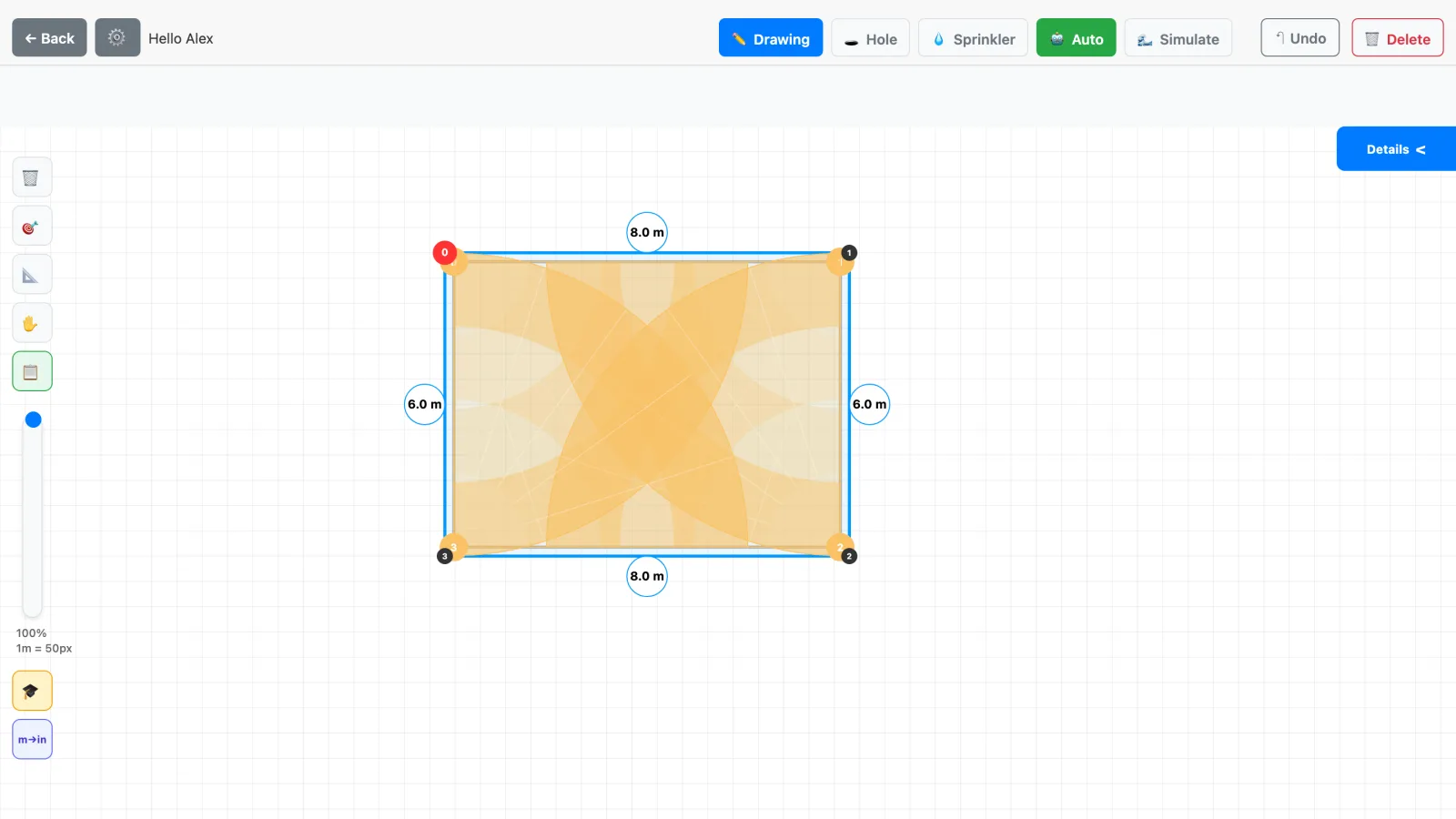
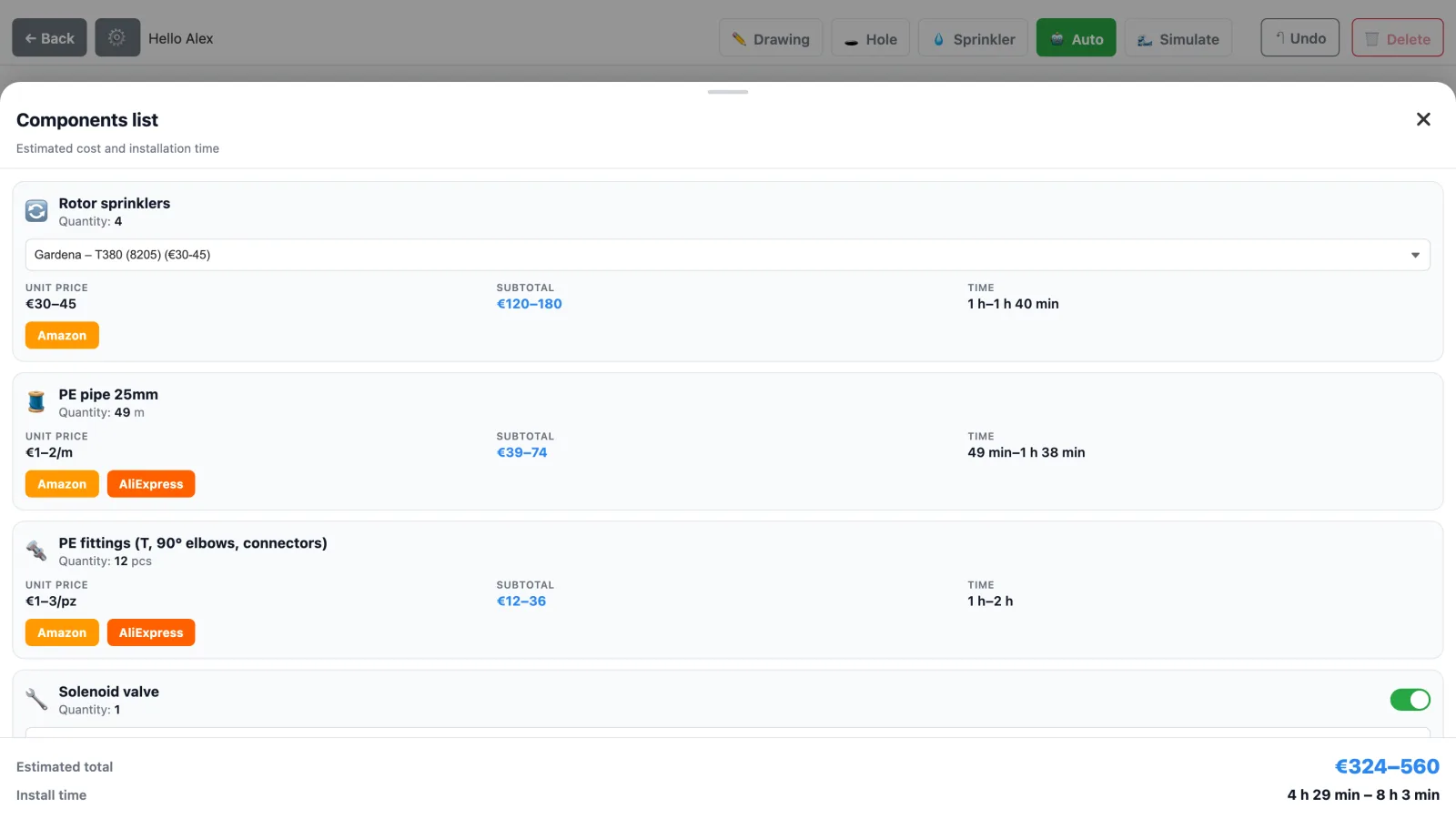
Instead of a cost per square foot pulled from nowhere, here are three lawns actually drawn in SprinklerMap: rectangles of 517, 861 and 1,615 sq ft. Every number in the table, heads, feet of pipe, coverage, gallons and parts cost, was calculated by the app on that drawing, with a complete parts list that includes the controller, a zone valve, a rain sensor and a soil-moisture sensor.
The first surprise is how little the parts bill grows with area: about 6% more for three times the lawn. More than half of it is fixed: controller, valve, sensors, fittings at the source. What really grows with area is the flow the lawn needs, and that is where the real cost steps come from.
| 517 sq ft (26 × 20 ft) | 861 sq ft (33 × 26 ft) | 1,615 sq ft (49 × 33 ft) | |
|---|---|---|---|
| Heads (rotors) | 4 · 19 ft radius | 4 · 26 ft radius | 4 · 32 ft radius |
| Pipe (25 mm / about 3/4 in) | 87 ft | 114 ft | 159 ft |
| Calculated coverage | 93.9% | 89.5% | 96.1% |
| Flow needed | 2.2 GPM | 4.0 GPM | 6.2 GPM |
| Water at summer peak | 83 gal/day | 131 gal/day | 265 gal/day |
| Parts (full list, app prices) | €307–527 | €313–539 | €324–560 |
| Estimated DIY install time | 4 h 7 min – 7 h 19 min | 4 h 15 min – 7 h 35 min | 4 h 29 min – 8 h |
Project 1 — 517 sq ft: the smallest system done right
On a 26 × 20 ft rectangle, automatic placement puts four rotors in the corners, 90° arcs, 19 ft working radius, with 93.9% calculated coverage. The parts list: four heads, 87 ft of pipe, a dozen fittings, one valve, a basic controller and the two sensors.
The number that matters on small lawns is flow: 2.2 GPM, which any outdoor spigot delivers. One zone, one valve, no hydraulic headaches. On lawns this size it is worth comparing heads with drip or low-volume nozzles too: /enSprinklers or drip? How to choose zone by zone, and how to add drip to an existing sprinkler system.
Project 2 — 861 sq ft: the weekend build
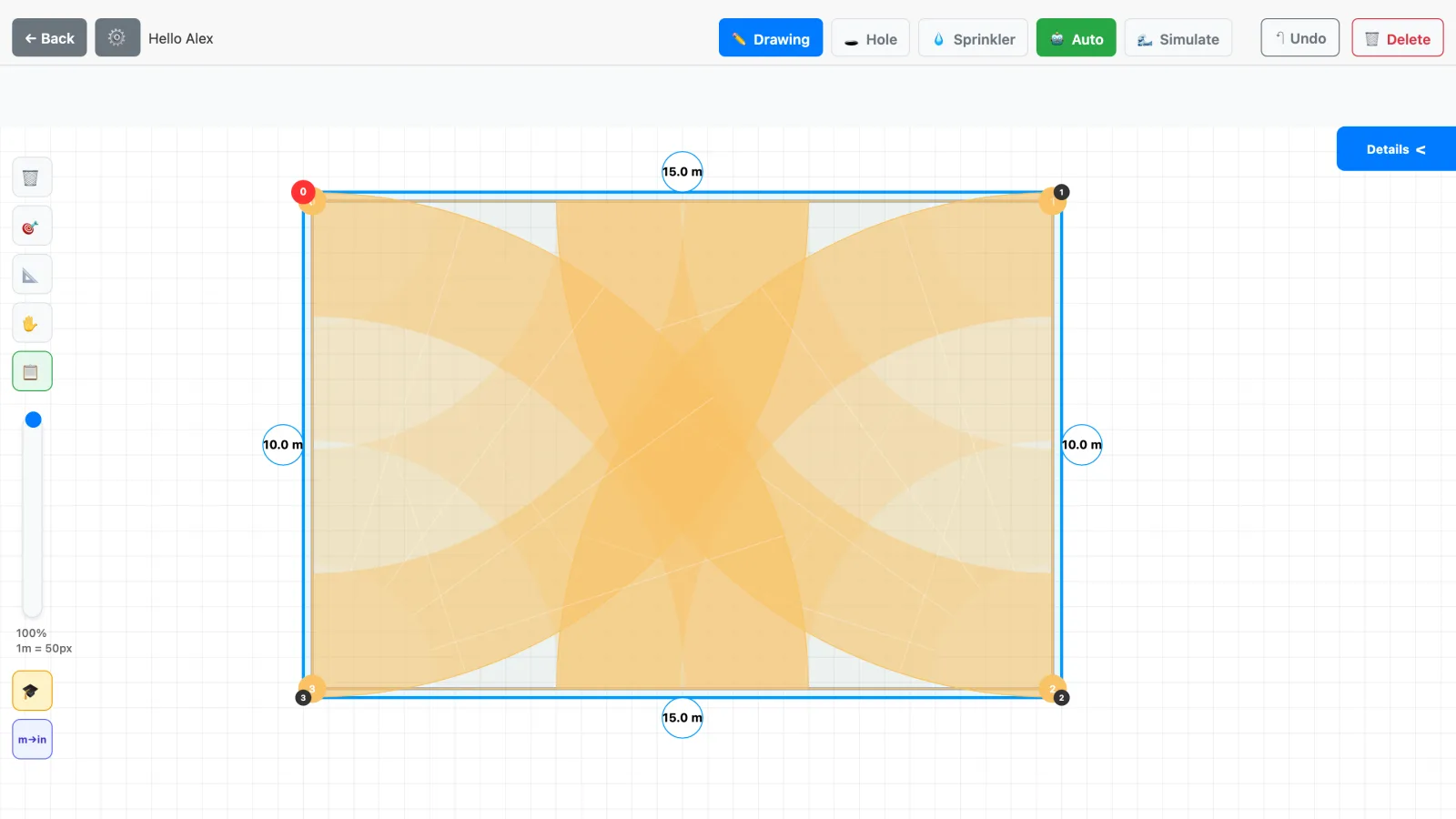
The middle project, 33 × 26 ft, is the one we documented step by step, from outline to watering simulation: /enHow to design irrigation for a rectangular garden. In short: four rotors with 26 ft radius in the corners, 89.5% coverage, 114 ft of pipe, 4.0 GPM, and 33 minutes of run time per day at the summer peak. Trenching on Saturday, laying and testing on Sunday.
Project 3 — 1,615 sq ft: where flow decides the price
On 49 × 33 ft the algorithm covers 96.1% with four rotors at 32 ft radius, and the parts list barely moves. The number that changes is the flow: 6.2 GPM for the whole lawn at once. Many US homes with a 3/4 in or 1 in service deliver 8 to 15 GPM at the hose bib, so this often still fits one zone with margin; older homes, long service lines and wells deliver less. Measure before you buy: a 5-gallon bucket and a stopwatch, method in /enHow to measure water pressure for irrigation.
If your measured flow minus a 20% margin is below what a zone needs, the zone gets split: a second valve, a few extra feet of pipe and fittings, and a controller with more stations. Run time doubles because zones run one after another; gallons do not. That, not square footage, is the real cost step of a sprinkler system.
What the parts list leaves out: the US-specific line items
- Backflow preventer: plumbing codes require one on any irrigation system connected to drinking water, typically a pressure vacuum breaker (PVB) installed at least 12 in above the highest head, or a reduced-pressure (RP) assembly. It is often the single most expensive part of the tie-in.
- Permit and inspection: many cities require a permit for an irrigation system on municipal water. Some do not; private wells feeding only irrigation are often exempt. Ask your building department.
- Annual backflow test: where required, a state-certified tester checks the device every year and files the report with the utility.
- Pressure-reducing valve: the International Plumbing Code requires a PRV where static pressure exceeds 80 PSI. If your house already has one, check its setting before you design around it.
- Call 811 before you dig: the national call-before-you-dig number gets public utility lines marked for free. Private lines (landscape lighting, sprinkler mains of a previous owner) are not marked.
- Valve box and trenching: a valve box is cheap; trenching by hand is free but slow, and a rented trencher saves most of a day on established lawns.
The cost that comes back every summer: water and sewer
At the summer peak SprinklerMap budgets 5 mm (about 0.2 in) of evapotranspiration per day for a full-sun cool-season lawn. Divided by a system efficiency of 0.72, that is about 170 gallons per 1,000 sq ft per day; the 861 sq ft project needs 131 gallons a day at peak. For reference, one inch of water on 1,000 sq ft is 623 gallons.
What a gallon costs depends entirely on your utility, and so does whether sewer is charged on irrigation water. Bluefield Research put the average combined monthly water and sewer bill in 2024 at about $142 in the Northeast and $118 in the South, with sewer making up nearly 60% of the bill. Three billing setups decide your summer cost: winter averaging (sewer billed on winter use, so irrigation pays water only), a separate irrigation or deduct meter (same effect, installed at your expense), or neither (every gallon pays water and sewer). Check your bill for the price per 1,000 gallons or per CCF (748 gallons) and which rule applies.
Hiring an installer: what quotes include
US cost guides quote typical residential installs from roughly $2,800 to $7,000, or about $590 to $1,340 per zone, with large regional differences. The gap to DIY is almost all labor, design and the tie-in work (backflow, permit, inspection).
Quotes are only comparable if they cover the same scope. The questions we always recommend asking: Are the backflow device, permit and first test included? Which head brand and which nozzles? Is the controller WaterSense labeled (it may qualify for a utility rebate)? Is design and initial programming included? What warranty covers labor? Is a fall blowout included in the first year?
Rebates that lower the price
Many US water utilities offer rebates for WaterSense labeled irrigation controllers, and some for rain or soil-moisture sensors, high-efficiency nozzles or turf replacement. The EPA estimates that replacing a clock timer with a WaterSense labeled controller can save an average home up to 15,000 gallons a year. Check your utility before you buy: rebates often require a specific model list and a receipt. More on smart controllers: /enSmart sprinkler controllers: what WaterSense and Wi-Fi actually save, rebates, and when the upgrade pays.
DIY or professional: the honest bottom line
DIY wins with two weekends, basic tool skills and, above all, a design checked before you buy. The expensive mistake is rarely the assembly; it is the layout and the flow math. Seeing coverage and GPM on the drawing before ordering parts removes most of that risk; the full DIY path is in /enDIY sprinkler system installation: the order of work, from permit and backflow to the final catch-cup test. A professional wins on complex lots, marginal pressure, large systems, and anywhere the local code expects licensed work on the tie-in. A sensible middle path: have a licensed plumber do the backflow tie-in and do the trenching and heads yourself.
Over the years the water often costs more than the install. Separate zones for lawn and beds, seasonal run-time adjustments, a rain sensor and the right billing setup with your utility pay back fastest. The cut-by-cut math is in /enHow to cut lawn irrigation water use: the gallons, the bill, and which change saves the most. And the first step costs nothing: draw your yard in the app and see how many heads, feet of pipe and gallons it really needs.
Frequently asked questions
How much does it cost to install a sprinkler system?
Published US cost guides put a typical professional residential install at roughly $2,800 to $7,000, or about $590 to $1,340 per zone, depending on yard size, region and head type. A DIY system on a small to mid-size lawn is mostly parts: the three projects in this article came to a few hundred dollars in materials, controller and sensors included.
What costs do people forget?
The backflow preventer most US codes require on any irrigation system tied to potable water, the permit many cities ask for, the annual backflow test where it is mandatory, a pressure-reducing valve if static pressure is above 80 PSI, and the water itself: at peak summer a full-sun lawn needs about 170 gallons per 1,000 sq ft per day.
Do I pay sewer charges on sprinkler water?
It depends on your utility. Many bill residential sewer on your winter average, so summer irrigation adds only water charges. Others let you install a separate irrigation or deduct meter. If neither applies, you pay sewer on every gallon, and sewer is often the larger part of the bill.
Recommended products
These product links are affiliate links: if you buy on Amazon or AliExpress through them it costs you nothing extra, but it helps us keep SprinklerMap alive as a project and create new useful content.
These products are catalogued in our brand database, with the same description and price range you find on the manufacturer page.

| Model | Type | Description | Radius (m) | Price (€) | Buy |
|---|---|---|---|---|---|
| 🔄 I-20 | Rotor | Professional rotor with anti-theft retractable bolt. High flow rate for large gardens. Arc 40°–360°. | 4.9–14 m | €22-40 | Amazon |
Other suggested products
Products not in the brand catalogue: generic material, tools and accessories where the right size matters more than the brand.
| Product | Description | Price (€) | Buy |
|---|---|---|---|
| Complete 6-zone DIY irrigation kit | Material kit for a 6-zone irrigation system: digital timer, 6 solenoid valves, filter, fittings, pop-up sprinklers and PE pipe. Enough for gardens up to 300 m². Installation manual included. | ~€250-450 | Amazon |
| Schedule 40 PVC pipe and fittings for the mainline | Schedule 40 PVC is the usual choice for the always-pressurized mainline from the backflow preventer to the valves. Check what your local code requires and size it on your largest zone flow. | ~€20-60 | Amazon |
| Electric trencher, rent or buy | Electric trencher for cutting 5-6 cm slots in established lawn. Cuts trenching for a 300 m² garden down to four hours. Available to rent at hardware stores or to buy outright. | ~€150-350 | Amazon |
| Product | Description | Price (€) | Buy |
|---|---|---|---|
| Pop-up spray heads 4" (set) | Set of 10 cm pop-ups with adjustable nozzles and the standard 1/2" thread: handy as spares or to finish secondary zones. | ~€12-30 | AliExpress |
| PE compression fitting kit, 16-25 mm | Assorted elbows, tees, couplers and end caps for PE pipe. Handy as a spares box: fittings always break on a Sunday. | ~€10-30 | AliExpress |
Technical note: The three parts lists were generated by SprinklerMap on the drawings in the screenshots, using the app's August 2026 price list and default settings (2.5 bar / 36 PSI, loam soil); the app prices lists in the currency of your location. Installer ranges are from published US cost guides and vary widely by region. Code requirements (backflow, permits, PRV) are set by your state and local jurisdiction; check with your building department and water utility.