The World Cup final pitch is not artificial turf (and why you should not copy it at home)
The 2026 World Cup final was played on engineered natural grass, not plastic turf. What grass they used, what is buried under the pitch, and why it is a terrible model for your own lawn.
The short answer, up front
Watch the 2026 World Cup final at MetLife Stadium, just outside New York, and the pitch looks almost too clean to be real grass. So a lot of people assume it must be one of those plastic surfaces you now see on five-a-side courts. Here is the answer, because the whole article hangs on it: the final was not played on artificial turf. It was real grass, grown from seed, just managed with a level of engineering no back garden will ever see.
The twist is that this particular stadium does use a synthetic surface all year round for American football. For the World Cup, FIFA had it removed and demanded natural grass instead. Understanding why they made that choice — and what is really sitting under those blades of grass — is the fastest way to stop chasing the wrong benchmark for your own lawn.
Engineered natural grass, not plastic
The final surface is real Bermudagrass (the Tahoma 31 cultivar, a warm-season grass), grown for roughly ten months on a sod farm in North Carolina and then trucked in as ready-made turf — something like twenty lorry-loads of it. The word that confuses everyone is 'hybrid'. A hybrid pitch is not half-plastic: it is 95%-plus living grass, with millions of thin synthetic fibres stitched into the root zone purely as reinforcement. The grass grows up around those fibres, the surface copes better with slides and hard turns, but what the players stand on is living turf.
That is a world away from the all-plastic, rubber-infilled artificial turf on a five-a-side court. In cooler or roofed stadiums FIFA used a different mix — roughly 84% Kentucky bluegrass and 16% perennial ryegrass, the same ryegrass we talk about for Wimbledon in What grass does Wimbledon use: mowing, lines and stripes explained — but again, natural grass, grown on plastic sheets and laid as sod. Across every stadium in the tournament, there is no plastic pitch.

What is buried under the pitch
This is where it gets slightly ridiculous. Under that grass at MetLife they built a full technical system. The permanent synthetic surface was buried under about two feet of sand, threaded with drainage, dedicated irrigation and — the detail that always gets us — a vacuum ventilation system that can pull or push air beneath the surface to manage moisture and root-zone temperature. In roofed venues, where the grass gets no direct sun, they also rolled in enormous LED grow-light rigs, like greenhouse lamps on wheels.
None of this is improvised. FIFA spent several million dollars with turfgrass universities to work out the seed mixes, the sod-transport method and the hybrid reinforcement. The payoff is a pitch that behaves identically from the first minute to the last, in conditions — closed roof, heat, back-to-back matches — that would flatten an ordinary lawn. You are not watching a well-kept garden. You are watching a piece of disposable engineering.
They removed the synthetic turf on purpose
It is worth sitting with that, because it flips the usual assumption. The final stadium already owns a perfectly good synthetic pitch that the NFL plays on every week. For the biggest match on the planet, they buried it under sand. The reason is simple: at the top level, football demands natural grass. Ball roll, ball bounce, stud grip and injury risk all behave differently on plastic, and players have pushed back against it for years.
Keep that in mind next time a salesperson pitches artificial grass as 'the same stuff the stadiums use'. The opposite is true: when it genuinely mattered, FIFA spent a fortune to take the synthetic out and put living grass in. Artificial turf has its honest uses — a heavily-used futsal court, a balcony, a shaded corner where nothing will grow — but it is not the surface of champions.
Why it is the wrong benchmark for your lawn
Now the practical bit, which is the whole reason we are writing this. The final pitch is spectacular precisely because it is everything a home lawn must not be. It is built to last about a month and then be scrapped — nobody keeps it alive for years, and the economics are nothing like yours. It sits on two feet of sand with forced drainage and ventilation you neither need nor want in a garden. It runs Bermudagrass on sand under near-constant irrigation, which in most temperate gardens would be unsustainable on water alone.
A real home lawn faces the opposite conditions: ordinary clay or loam rather than golf-grade sand, watering you often have to keep low during summer restrictions (see When to Water Your Garden in a Heatwave: Timing, Amounts and Mistakes to Avoid), and a surface that has to survive for years, not thirty days. Copying the stadium means copying the look while ignoring the one thing that matters at home: lasting the distance. It is a bit like commuting in a Formula 1 car — glorious on track, useless on the school run.
The "lawn like on TV" trap
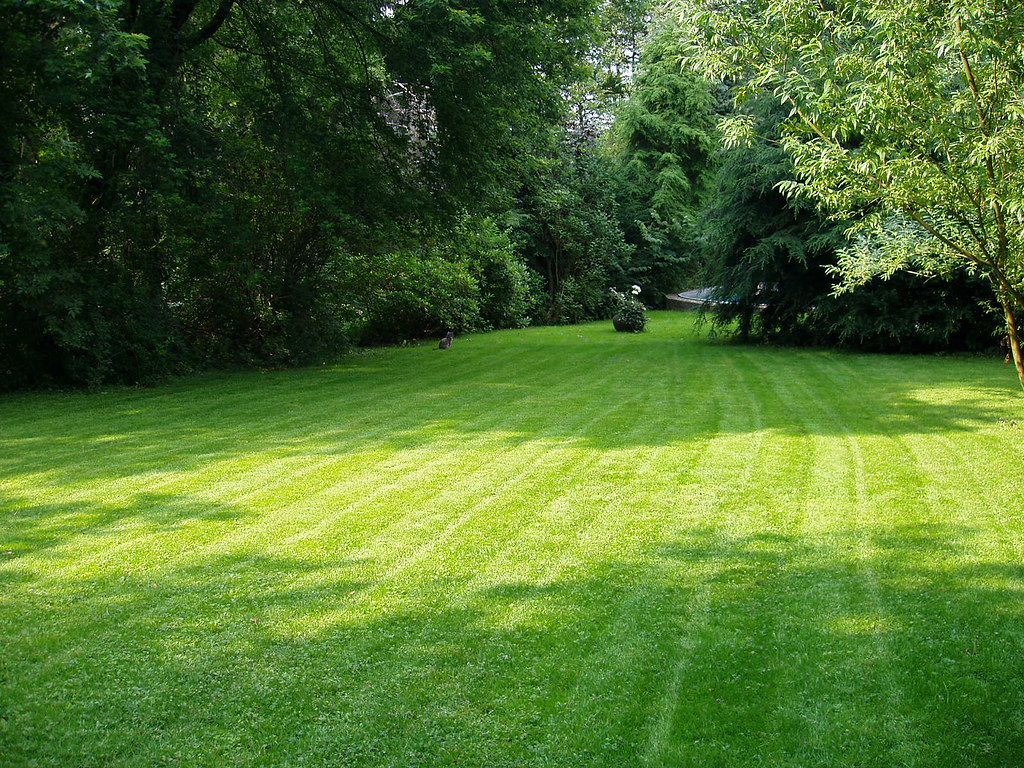
The second myth is subtler and it is about looks. That billiard-table green and those crisp stripes do not come from a magic species or a secret feed. They come from very low daily mowing, rolling, a dedicated crew and — on tournament grounds — constant play rotation. And the light-and-dark stripes are not even a different grass: it is simply light reflecting the opposite way depending on which direction the roller bends the blades, exactly the effect we explain for tennis courts in What grass does Wimbledon use: mowing, lines and stripes explained.
In plain terms: you can get close to that look at home, but by changing how you treat the lawn, not by chasing the stadium surface. A roller mower gives you the stripes; regular mowing and even watering give you the dense green. What you cannot (and should not) copy is the cutting height — dropping to a centimetre like on TV, without the rest of the system underneath, just scorches the roots and rolls out the welcome mat for drought and weeds.
What actually gives you a great home lawn
Start where you actually have an advantage: your own garden. The first lever is not a stadium species, it is choosing the right seed for your climate and use. In Lawn seed types: brands, mixes and what to choose we compare the seed mixes that are genuinely available, including hard-wearing blends that make far more sense than golf Bermuda for a family with kids and a dog. A mix suited to your soil will save you water and effort for years.
After that come the three things that matter more than any tournament cultivar: a sensible cutting height (for most temperate lawns that is around 30-40 mm, not one), watering tuned to your soil type — clay and sand behave in opposite ways, as we set out in How long to run sprinklers: minutes per cycle by soil and head type, with the math behind them — and consistency. The lawn your neighbours envy does not come from imitating a stadium; it comes from doing four or five simple things well, for years. The World Cup final is an engineering spectacle to enjoy on TV. Your garden is a different thing entirely, and that is a good thing.
Recommended products
These product links are affiliate links: if you buy on Amazon or AliExpress through them it costs you nothing extra, but it helps us keep SprinklerMap alive as a project and create new useful content.
These products are catalogued in our brand database, with the same description and price range you find on the manufacturer page.

| Model | Type | Description | Radius (m) | Price (€) | Buy |
|---|---|---|---|---|---|
| 🌱 Royal Sport | Seeds | Mixture for turf under intensive use. Designed for fast recovery, foot traffic and more frequent maintenance. | — | €90-180 | Amazon |
Other suggested products
Products not in the brand catalogue: generic material, tools and accessories where the right size matters more than the brand.
| Product | Description | Price (€) | Buy |
|---|---|---|---|
| Hard-wearing lawn seed (family blend) | A hard-wearing grass seed mix built to take foot traffic from kids and pets — the realistic, sustainable alternative to stadium Bermudagrass. | ~€15-45 | Amazon |
| Cylinder mower with rear roller | A cylinder (reel) mower with a rear roller — the same mechanism used on tournament grounds to produce stripes and a dense finish, without cutting dangerously low. | ~€120-400 | Amazon |
| Irrigation controller with rain skip | A tap timer or controller to tune watering to your soil and skip cycles after rain — far more useful in a real garden than any stadium system. | ~€20-70 | Amazon |
| Manual lawn aerator / scarifier | A rolling aerator with blades to break up soil compaction on worn paths — basic care that matters more than any tournament cultivar. | ~€20-55 | Amazon |
| Product | Description | Price (€) | Buy |
|---|---|---|---|
| Zigbee/WiFi soil moisture sensor | Wireless in-ground probe reporting soil moisture and temperature in-app. With Home Assistant or Zigbee2MQTT it becomes the trigger to skip pointless cycles. | ~€8-20 | AliExpress |