Flow and pressure calculation: example with real data
2.9 bar static at the garden tap, 18 L/min maximum flow. How to derive the design pressure, estimate head loss, and calculate how many sprinklers can fit on each circuit.
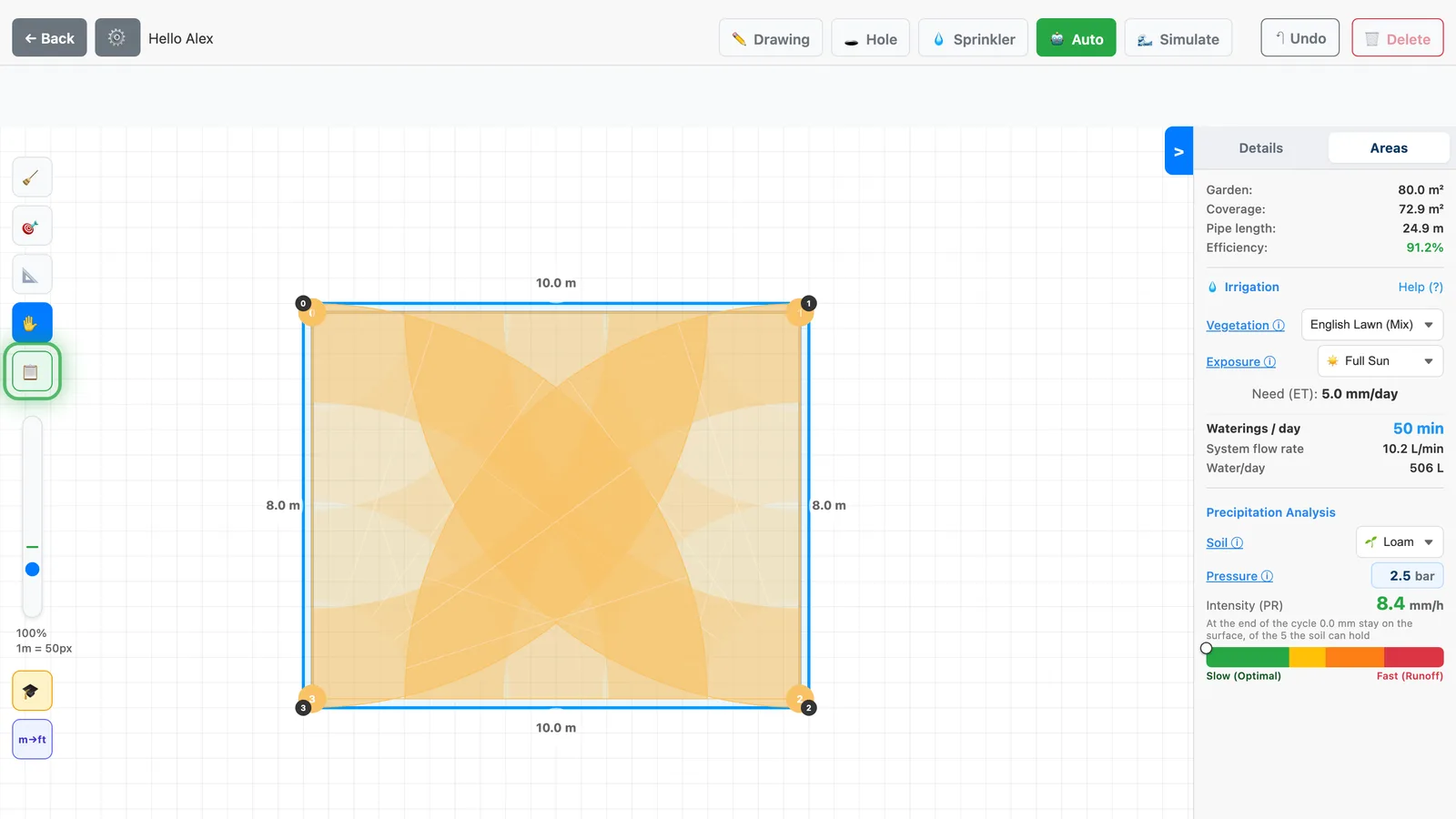
Includes the lawn and its sprinklers. A free account is required: the garden is copied to your account, where you can change it.
Step 1: measure the pressure
Required tool
Pressure gauge with a 1/2" threaded fitting for an outdoor tap. Cost: €10–18 at a hardware store or irrigation shop. Screw it onto the garden tap (not an indoor tap).
Static measurement
All taps in the house closed. Open the garden tap slowly, wait 10 seconds. Reading: 2.9 bar.
Dynamic measurement
With the gauge still attached, open a tap inside the house and re-read after 15 seconds. Reading: 2.5 bar.
The difference (0.4 bar) indicates the load on the water mains. The design value is always the dynamic pressure: 2.5 bar.
Step 2: measure the maximum flow rate
Bucket method
Remove the gauge, open the tap fully, fill a 10-liter bucket and time it.
Result: 10 liters in 33 seconds.
Calculation: (10 liters / 33 seconds) × 60 = 18.2 L/min
This is the maximum available flow. The system cannot use more than this. In practice, at most 75–80% for margin: 18.2 × 0.78 = 14.2 L/min as the operating limit.
Step 3: calculate head loss
Components and estimated losses
- PE 25 mm pipe, 24.9 m at 10.2 L/min: loss about 0.04 bar
- 1" mesh filter (clean): 0.07 bar
- Open 1" solenoid valve: 0.15 bar
- 3 T-fittings on the main pipe: 0.04 bar
- 4 branches of 16 mm PE, 0.5 m, to the rotors: 0.01 bar
Estimated total loss: 0.31 bar
Pressure available at the farthest rotors: 2.5 − 0.31 = about 2.2 bar
The app calculates flow at the pressure you enter, 2.5 bar. The farthest rotors receive about 2.2 bar and their flow drops slightly, because flow varies with the square root of pressure, so the calculation in step 4 stays on the safe side. Before buying nozzles, check on the datasheet that they reach 7.8 m at 2.2 bar.
Step 4: calculate the maximum number of sprinklers per circuit
Project data
10 × 8 m lawn with 4 rotors set to 90° in the corners, 7.8 m radius, and 24.9 m of pipe. Coverage: 72.9 m² out of 80 m². At 2.5 bar the app calculates a system flow of 10.2 L/min: 10.2 / 4 = 2.55 L/min per rotor.
Calculation
Operating flow limit: 14.2 L/min
Flow per rotor: 2.55 L/min
Maximum number of rotors: 14.2 / 2.55 = 5.6 rotors
Rounded down to 5 rotors per circuit. With 4 rotors on the 10 × 8 m lawn, the circuit is within limits (4 × 2.55 = 10.2 L/min < 14.2 L/min).
Check with multiple zones
If the lawn is large and 10 rotors are needed, split them into 2 circuits of 5. The two circuits run in sequence, so the maximum simultaneous flow remains that of a single zone: 5 × 2.55 = 12.75 L/min < 14.2 L/min.
Method summary
- Design pressure = measured dynamic pressure
- Estimated total losses = 0.3–0.6 bar (pipe + valve + filter)
- Pressure at sprinklers = dynamic − total losses
- Sprinklers per circuit = (maximum flow × 0.78) / sprinkler flow at actual pressure
Generate the project for your garden
These examples show typical scenarios. Use SprinklerMap to calculate a precise layout, pressures and materials list for your real situation.