Pop-up spray sprinklers: how to choose and the best models
Pop-up spray sprinklers are the ideal solution for gardens up to 200 m². Learn how they work, when to choose them over rotors, and which models offer the best value.

Disclosure and methodology
How this selection is built: technical data (throw, flow, working pressure, compatible nozzles) comes from the manufacturers' public spec sheets and catalogues; prices are ranges observed on major retail channels in August 2026. We received no samples or compensation from manufacturers; some links are affiliate links, flagged where they appear, and they influence neither ranking nor judgements. Before buying, always check the specs at YOUR real pressure: it is the single factor that changes field performance the most.
The models reviewed here are the ones most commonly installed in residential gardens across Europe, even where a product is harder to find in shops today.
This is a specification comparison; we did not run tests. It is built from the manufacturers' official datasheets (Rain Bird, Hunter, Toro, K-Rain, Gardena) and public product documentation. None of these models were tried on site by us: where field behaviour is described, the figure is the one the manufacturer states. For the technical fundamentals of spray heads and nozzles, see How to choose sprinkler nozzles for uniform lawns. Here we cover only the pop-up bodies and which model to choose.
The test bench: why sprays do not forgive spacing
The test bench is the same 10×8 garden from our case studies, simulated in the app with two layouts: short throws spaced as if they were rotors, and the correct head-to-head grid. The collapse from 89-96% to a measured 15.0% comes from the short throw, not from the quality of the sprays. A 4 m spray imposes a grid no wider than 4 m, so the 10×8 bench needs about 12 heads on a square grid (four along the 10 m side, three along the 8 m side), not 4. The full comparison project, with all simulations, is at /esempi/prima-dopo-head-to-head.
With sprays the per-unit price misleads twice: you need more units, and units spaced too far apart perform poorly. Before comparing models, draw your garden and count how many heads you need at your nozzle's real radius at your pressure. Compare two sprays on that number multiplied by the price.
| Layout on the 10×8 bench (80 m²) | Units | Measured coverage |
|---|---|---|
| Short throws spaced 5-6 m (the typical mistake) | 4 | 15.0% |
| Head-to-head with radius matched to the side | 4 | 89.5–96.4% |
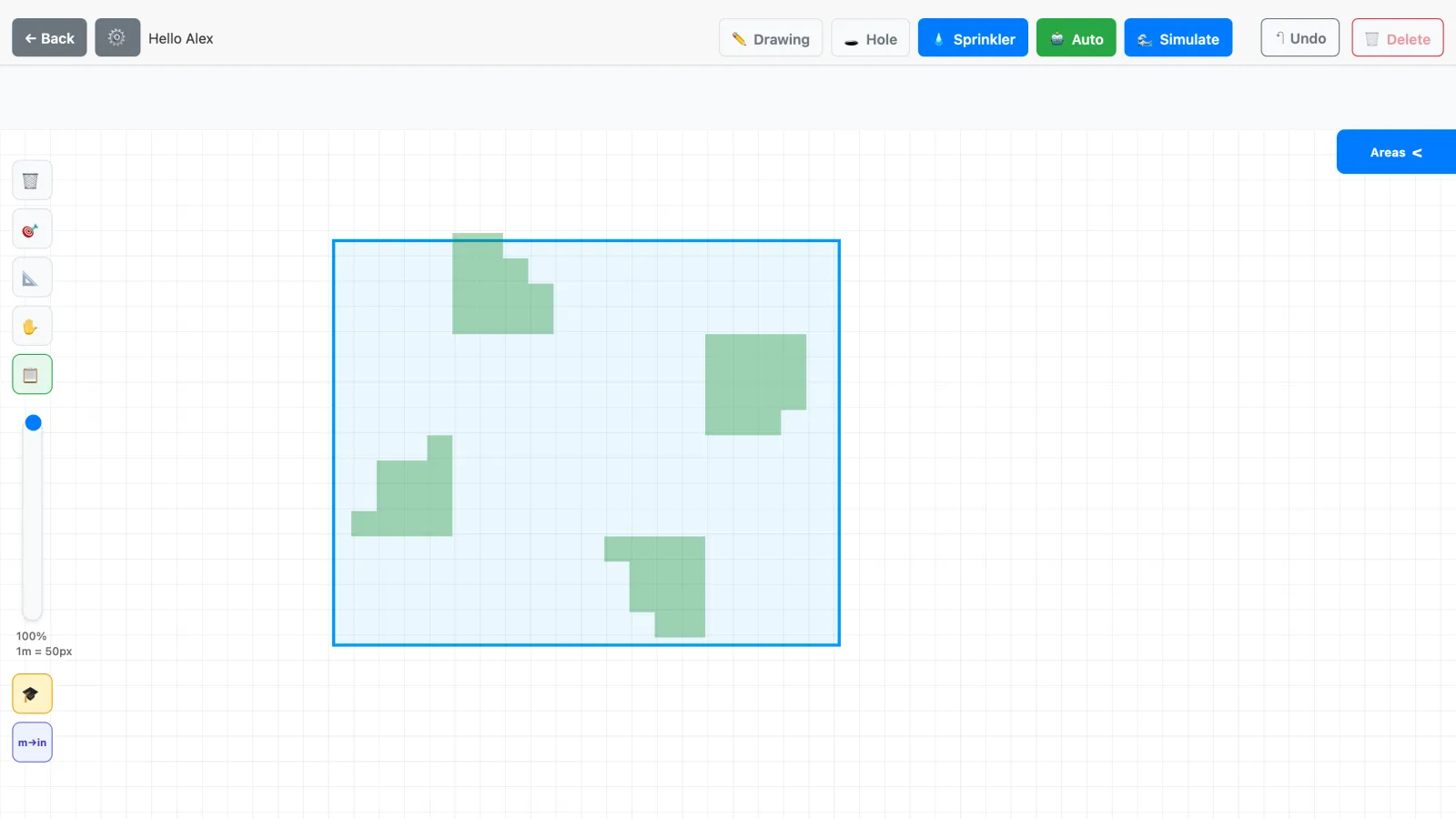
Manufacturer-declared data, side by side
Ranges come from the manufacturers' public sheets; with sprays they need care, because body and nozzle are bought separately and the declared radius belongs to the nozzle. The MP Rotator is a rotating nozzle that mounts on a spray body and reaches rotor-class radii with a low precipitation rate, useful when a plain spray radius is not enough and you do not want to change bodies. Before buying, read the curve at your pressure and count the heads on your drawing.
| System (body + nozzle) | Working pressure | Declared radius | Observed price (Aug 2026) |
|---|---|---|---|
| Hunter Pro-Spray + MP Rotator | 1.7–3.8 bar (optimal ~2.8) | 2.5–10.7 m | €8–18 + nozzle |
| Rain Bird 1804 + MPR/U nozzles | 1.0–2.1 bar (spray nozzles) | 1.5–4.6 m | €5–12 |
| Toro 570Z + series nozzles | 1.4–3.4 bar | 1.5–4.6 m | €6–14 |
What separates one spray body from another
From the outside most spray bodies look alike, a plastic cylinder with a retractable stem. The differences that matter come down to five points: (1) material quality (ABS+PC vs plain ABS vs generic plastic), (2) whether an anti-drain SAM valve is fitted, (3) the quality and serviceability of the internal filter, (4) whether a built-in pressure regulator (PRS) is included, and (5) the mechanical tolerances of the stem, which determine how quickly it wears loose over the years.
Stem height (4", 6", 12") depends on the planting, not on quality. 4" (about 10 cm) suits regularly mown lawns. 6" (15 cm) suits taller grass or low bedding plants. 12" (30 cm) clears low hedges or tall flower beds. The main brands offer all three heights (see the comparison table below).
Comparison table: every model at a glance
The table below summarises the most relevant residential models. Indicative Amazon.co.uk prices (June–July 2026); specialist retailers may differ. Inlets are 1/2" female thread (NPT on North American models, BSP on versions sold elsewhere), and Rain Bird, Hunter, Toro and K-Rain stems all take female-threaded nozzles, so most nozzles swap between brands; check the radius chart of the nozzle you actually fit.
PRS (Pressure Regulating System) means a built-in regulator that holds pressure at the nozzle at a fixed value, 30 psi (2.1 bar) on spray bodies; Hunter and K-Rain also make 40 psi (2.8 bar) versions for MP Rotator nozzles. Useful when static pressure exceeds about 3.5 bar, to prevent misting. SAM (Seal-A-Matic on Rain Bird, check valve or CV on Hunter, Toro and K-Rain) is the anti-drain valve that stops pipes emptying through the lowest heads at the end of a cycle, useful on sloped gardens. On most bodies both are versions you order, not standard features.
| Model | Heights | Check valve | PRS | Price (Amazon UK) |
|---|---|---|---|---|
| Rain Bird 1804 | 4" | 1804-SAM version | 1804-PRS version | £4-8 |
| Rain Bird 1806 / 1812 | 6" / 12" | SAM version | PRS version | £5-12 |
| Rain Bird 1804-SAM-PRS | 4" | Yes | Yes (2.1 bar) | £10-16 |
| Hunter Pro-Spray (PROS-04) | 4" | PROS-04-CV version | PRS30 / PRS40 versions | £5-10 |
| Toro 570Z PRX | 2" to 12" | COM version | Yes (2.1 bar) | £6-14 |
| K-Rain Pro-S | 2" to 12" | CV version | PR30 / PR40 versions | £3-7 |
Rain Bird 1804: the world standard
The Rain Bird 1804 is one of the most widely installed residential spray bodies and the easiest to find in shops. Datasheet: 4" (10 cm) pop-up height, 1/2" female inlet, UV-resistant body, mesh filter. The check valve and the regulator are separate versions: 1804-SAM (Seal-A-Matic), 1804-PRS (regulated to 30 psi) and 1804-SAM-PRS with both. Base version £4-8; SAM version £6-10; SAM-PRS version £10-16.
Strengths: spares available at any specialist retailer and a huge range of compatible nozzles. Weaknesses: the base version has no check valve, so on sloped gardens the low heads drain the line after shutoff, and the SAM version costs nearly 50% more. Real lifespan depends on UV exposure, water quality and installation; Rain Bird does not publish a rated life. Flat garden: base version. Slope above 5%: SAM version. Static pressure above 3.5 bar: SAM-PRS version, which saves fitting a separate reducer.
Rain Bird 1806/1812 and Hunter Pro-Spray: when you need more height
The 1806 (15 cm) and 1812 (30 cm) are identical to the 1804 apart from stem length. Choose the 1806 for lawns left to grow taller or low ground cover, and the 1812 for shrubs up to about 25 cm or low hedges; above that height even the 1812 is blocked, and bubblers or drip are the better choice. A longer stem flexes more in strong wind, so the 1812 is a poor choice in exposed, windy spots.
The Hunter Pro-Spray (PROS-04) is the direct rival to the 1804: same 4" height and 1/2" inlet, with 6" and 12" versions. As with Rain Bird, the drain check valve is a version you order (PROS-04-CV, rated by Hunter for up to about 3 m of elevation), and the regulated PRS30 and PRS40 versions hold 30 or 40 psi at the nozzle. Price £5-10 for the base body. Hunter also sells Pro Adjustable nozzles; they are a nozzle line, not a body, and fit any body that takes female-threaded nozzles.
Toro 570Z PRX: regulator built in
The Toro 570Z PRX has a regulator in the riser that holds 30 psi (2.1 bar) at the nozzle and limits flow if a nozzle is knocked off. It comes in pop-up heights from 2" to 12", with a check valve in the COM versions (not available on side-inlet bodies). Price £6-14 depending on height.
It suits gardens with static pressure above 3 bar where you want a built-in regulator. Before buying, check that the shop you use stocks the COM version and Toro spares; in many areas Rain Bird and Hunter parts are easier to find locally.
K-Rain Pro-S and Gardena: budget or legacy system
K-Rain is the lesser-known American brand in the UK market. The Pro-S costs £3-7, up to 40% less than a base Rain Bird 1804, with honest residential-grade specs: pop-up heights from 2" to 12", rated for 20-70 psi, a field-installable check valve (CV versions, about 3 m of head) and 30 or 40 psi regulated versions (PR30, PR40). The caveat is spares, which are harder to find at UK retailers and mostly online. Suits budget-constrained projects.
Gardena Sprinklersystem pop-ups such as the S 80 are now listed by Gardena as legacy models, with spare parts still available. They only make sense to repair or extend a Gardena system you already have; for a new install, pick one of the bodies above.
Decision questions and final verdict
Question 1: what is your static pressure? Above 3.5 bar, pick a regulated body (Rain Bird 1804-SAM-PRS, Hunter PROS-04-PRS30 or Toro 570Z PRX) instead of fitting a separate regulator. To measure pressure, see How to measure water pressure for irrigation. Question 2: does the garden slope? Above 5%, order the check valve version (1804-SAM, PROS-04-CV, 570Z COM or Pro-S CV). Question 3: how much does unit price matter? At about £5 for a base 1804 and £12 for a regulated body with check valve, 15 heads differ by about £105; across 4-5 heads the difference is £30-35 and the better model is worth it.
Default recommendation for the average residential garden (2-4 zones, flat lawn): Rain Bird 1804 base or Hunter PROS-04. For sloped or mixed terrain: the SAM or CV version. For high static pressure: Rain Bird 1804-SAM-PRS, Hunter PRS30 or Toro 570Z PRX. For large installs (15+ heads) on a tight budget: K-Rain Pro-S. To work out the total system budget, see How much does a sprinkler system cost? Parts, installer quotes, backflow, and the water bill nobody budgets.
Frequently asked questions
My spray head waters a path as well as the lawn. How do I fix it?
Rotate the nozzle arc to exclude the hard surface, then check if the radius is too large. If the path is within the sprinkler's throw radius even with the arc corrected, reduce the radius via the adjustment screw (maximum 25% reduction without significant uniformity loss) or move the head inward.
Can I use a 6" (15 cm) pop-up body instead of 4" where grass is tall?
Yes. Taller pop-up heights (5 cm, 10 cm, 15 cm) prevent tall grass or ground cover from blocking distribution. Use 10 cm pop-ups for grass kept above 5 cm, and 15 cm bodies for ornamental grasses or low shrubs. The taller body costs only slightly more per head.
Do spray heads need winterising in mild climates?
Where the ground does not freeze, spray heads usually need no special winterising. Where it does, drain the system or blow it out with compressed air one zone at a time, keeping the air at no more than 50 PSI (about 3.5 bar) for poly pipe, so water cannot freeze and split pipes, fittings or bodies. The full procedure is in How to winterize a sprinkler system: drain or blow out, protect the backflow preventer, and restart in spring.
Recommended products
These product links are affiliate links: if you buy on Amazon or AliExpress through them it costs you nothing extra, but it helps us keep SprinklerMap alive as a project and create new useful content.
These products are catalogued in our brand database, with the same description and price range you find on the manufacturer page.

| Model | Type | Description | Radius (m) | Price (€) | Buy |
|---|---|---|---|---|---|
| 💧 1804 | Pop-up | Residential 10 cm pop-up body, the most common choice for lawns. VAN or MP nozzle bought separately; broad compatibility with all standard nozzles. | 1.5–5 m | €3-9 | Amazon |

| Model | Type | Description | Radius (m) | Price (€) | Buy |
|---|---|---|---|---|---|
| 💧 570Z Pro | Pop-up | Pop-up with integrated pressure regulator (PRS). Maintains constant flow from 1.4 to 5.5 bar. Ideal for systems with variable pressure. | 1.2–5.5 m | €5-12 | Amazon |
Other suggested products
Products not in the brand catalogue: generic material, tools and accessories where the right size matters more than the brand.
| Product | Description | Price (€) | Buy |
|---|---|---|---|
| Hunter Pro-Spray PROS-04 | Hunter 4" pop-up spray body with 1/2" inlet, sold without nozzle; takes standard female-threaded spray nozzles. Order the PROS-04-CV version if you need a check valve on a slope. | ~€5-10 | Amazon |
| Product | Description | Price (€) | Buy |
|---|---|---|---|
| Generic 4" pop-up spray body (AliExpress) | Generic equivalent of the 4" professional pop-up body. Compatible with 1/2" threaded nozzles. A low-cost option for small and medium systems. | ~€2-6 | AliExpress |
| Adjustable spray nozzle kit (AliExpress) | Set of spray nozzles with 90°, 180°, 360° sectors and adjustable radius up to 5 m. Standard 1/2" thread, compatible with most pop-up bodies on the market. | ~€1-4 | AliExpress |
Technical note: The specs, coverage radii and price ranges quoted in this article are based on manufacturer datasheets and public catalogues. None of the models mentioned was tested directly: the comparison is on the specifications declared by the manufacturers. Figures can vary between models and after a product line is updated. Before buying, always check the current datasheet of the specific product you're considering, since stated performance changes with the actual operating pressure of your system.