Pop-up rotor sprinklers: complete guide to the best models
Rotor sprinklers cover radii from 5 to 15 metres and are perfect for large lawns. Discover how they work, their advantages over spray heads, and the most reliable models.

How a rotor sprinkler works
How this selection is built: technical data (throw, flow, working pressure, compatible nozzles) comes from the manufacturers' public spec sheets and catalogues; prices are ranges observed on major retail channels in August 2026. We received no samples or compensation from manufacturers; some links are affiliate links, flagged where they appear, and they influence neither ranking nor judgements. Before buying, always check the specs at YOUR real pressure: it is the single factor that changes field performance the most.
A rotor pop-up rises from the ground like a spray head, but instead of delivering water statically, the head rotates slowly back and forth across a set arc. This rotation allows coverage of radii from 5 to 15 metres at a much lower flow rate per unit of time.
The hydrological advantage is significant: by delivering water more slowly, the soil can absorb it before surface run-off forms. On sloped lawns or clay soils, this can be the difference between an efficient system and one that wastes water.
The test bench: measured coverage by radius class
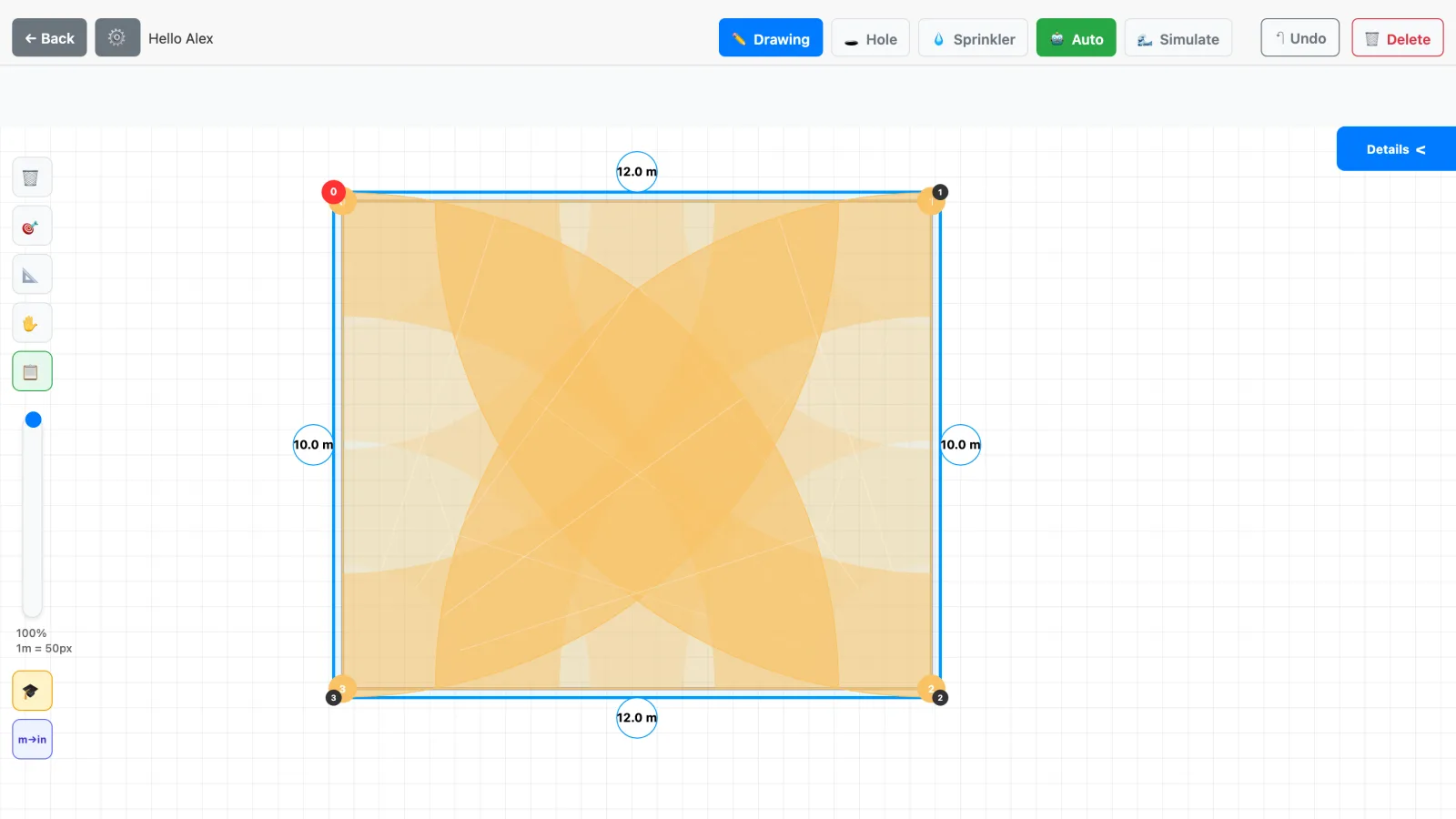
Instead of adjectives, a reproducible test bench: four standard rectangular gardens drawn in SprinklerMap, head-to-head auto placement, wetting simulation, coverage measured by the app. They are the same projects documented in our case studies (How to design irrigation for a rectangular garden and How much does a sprinkler system cost? Parts, installer quotes, backflow, and the water bill nobody budgets): anyone can redraw them and get the same numbers.
For rotor buyers, the variable that decides everything is the real radius at your pressure, because it sets how many units you need and therefore the cost per covered square metre. Four rotors are enough as long as the radius at 2.5 bar nearly reaches the lawn's short side; below that threshold you need six, and costs rise accordingly. The best rotor for your garden is the one whose pressure-radius curve covers your side head-to-head, not the one with the highest brochure radius.
| Real radius at 2.5 bar | Test garden | Units | Measured coverage |
|---|---|---|---|
| ~5.8 m | 48 m² (8×6) | 4 | 93.9% |
| ~7.8 m | 80 m² (10×8) | 4 | 89.5% |
| ~9.8 m | 120 m² (12×10) | 4 | 98.3% |
| ~9.8 m | 150 m² (15×10) | 4 | 96.1% |
Manufacturer-declared data, side by side
Ranges come from the manufacturers' public spec sheets and catalogues and depend on the installed nozzle: maximum radius is only reached with the largest nozzles at the highest pressures. To use this table, measure your dynamic pressure (How to measure water pressure for irrigation), open the model's official curve, read the radius at your pressure with the nozzle you plan to install, and check that number on your garden's drawing before buying.
| Model | Working pressure | Declared radius | Arc | Observed price (Aug 2026) |
|---|---|---|---|---|
| Hunter PGP Ultra | 1.7–4.8 bar | 4.9–14.0 m | 50–360° | €12–26 |
| Rain Bird 5000 | 1.7–4.5 bar | 7.6–15.2 m | 40–360° | €18–35 |
| Toro T5 RapidSet | 1.7–4.8 bar | 7.6–15.2 m | 40–360° | €28–50 |
Traditional rotors vs MP Rotators
Traditional rotors (Rain Bird 5004, Hunter PGP) use an internal gear to rotate the head. They are robust, reliable, and cover large radii, good for lawns over 100 m².
MP Rotators (Hunter MP2000/MP3000) are a hybrid: they mount on standard pop-up bodies in place of spray nozzles, but deliver water via rotating streams at a very low flow rate. The MP Rotator range covers about 1.8–10.7 m depending on the model, and excels on medium gardens where slope or compacted soil makes spray heads inefficient.
When to choose rotors over spray heads
Use rotors when: the required radius exceeds 4 metres, the garden is on a slope, the soil is clay-heavy and absorbs slowly, or the total surface exceeds 200 m².
Never mix rotors and spray heads on the same hydraulic circuit: spray heads apply around 40 mm/h and rotors roughly 10–20 mm/h, so with the same minutes one group will always be under- or over-irrigated.
Setting the arc and radius
All professional rotors allow you to set the rotation arc (from 40° or 50° up to 360°, depending on the model) and adjust the radius via a flow-reduction screw. Do not reduce the radius by more than about 25%: larger reductions compromise distribution uniformity.
Pressure and flow: sizing the circuit
On a rotor the flow is set by the nozzle, not by the arc: a Rain Bird 5004 at 2.5 bar uses about 5.4 L/min (1.4 GPM) with the standard 1.5 nozzle, throwing about 10.4 m, and about 27 L/min with the 8.0 nozzle. Read the flow of the nozzle you plan to fit in the datasheet before deciding how many rotors share a valve.
Total circuit flow must stay under 80% of available flow. With 15 L/min available the budget is 12 L/min: two rotors with the 1.5 nozzle (10.8 L/min) per valve, not five or six.
The most reliable models
The Rain Bird 5000 series and the Hunter PGP family have long been professional benchmarks: replacement parts are available at any irrigation supplier and both are easy to service in the field. The Hunter MP Rotator suits medium gardens with slopes or clay soil, where its low precipitation rate (about 10 mm/h) gives the water time to soak in. Gardena T380 is the most accessible consumer option for those who prefer a simpler setup.
For large gardens over 500 m², look at the Rain Bird 5000 with its larger nozzles (up to 15.2 m) or the Hunter I-20 (up to about 14 m), both widely specified on commercial projects.
Key takeaways
Rotor sprinklers are the right choice for lawns over 100 m², sloped surfaces, or clay soils where spray heads cause run-off. Never mix rotors and spray heads on the same zone, because their precipitation rates are too different. Set arc and radius during installation: keep radius reductions under 25% to preserve distribution uniformity. Use Rain Bird 5004 or Hunter PGP Ultra for professional longevity; Hunter MP Rotators where ultra-low flow is the priority.
What to avoid
Unbranded budget rotors ($3-6) from generic marketplace listings: manufacturing tolerances are inconsistent from unit to unit, spare parts rarely exist, and nozzles are rarely matched-precipitation-rate, which breaks zone uniformity even with perfect spacing. Each head that fails means digging it out and replacing it whole. Also avoid metal impact-drive rotors (the classic "tac-tac-tac" garden sprinklers) for a permanent system: they sit above grade, are noisy, and their edge distribution is poor.
Budget reference for a full install
For a 1,000-1,600 sq ft (100-150 m²) lawn with 8 Rain Bird 5004 rotors: roughly $18-33 per head means $145-260 in rotors alone, plus $25-40 in PE pipe and $20-35 in fittings and saddle clamps. For a larger 3,200-5,400 sq ft (300-500 m²) garden with 15-20 rotors at the same price per head: $270-660 in rotors, $45-75 in pipe and $45-65 in fittings. Price the valves and the controller last, because how many valves you need depends on your flow: with 15 L/min (4 GPM) available, 80% is about 3.2 GPM, which takes two rotors with the 1.5 nozzle, so 8 rotors already need four valves. Installation quotes vary a lot by region; how to compare them is in How much does a sprinkler system cost? Parts, installer quotes, backflow, and the water bill nobody budgets.
Frequently asked questions
Why do my rotor sprinklers leave dry patches near the outer edge?
The most common cause is radius set too large for the available pressure. Measure actual operating pressure during irrigation: if it is below the sprinkler's rated minimum (typically about 1.7 bar, 25 PSI), reduce the radius via the adjustment screw or add more heads to reduce spacing.
Can I mix rotor and MP Rotator heads on the same zone?
Only if they are within the same precipitation rate range. Gear-driven rotors apply roughly 10–20 mm/h (indicative) and MP Rotators around 10 mm/h, so the two can be close, but check the precipitation rate of each nozzle at your pressure before mixing. The safest design still keeps them on separate zones, because a gear rotor's precipitation rate changes with its nozzle and spacing.
How often do pop-up rotor heads need servicing?
On a quality system (Rain Bird, Hunter), routine maintenance is cleaning the filter annually and checking arc and radius settings at the start of each season. A rotor head that does not rotate is almost always caused by a clogged filter, not a mechanical failure. Clean first, replace only if cleaning does not restore rotation.
Recommended products
These product links are affiliate links: if you buy on Amazon or AliExpress through them it costs you nothing extra, but it helps us keep SprinklerMap alive as a project and create new useful content.
These products are catalogued in our brand database, with the same description and price range you find on the manufacturer page.

| Model | Type | Description | Radius (m) | Price (€) | Buy |
|---|---|---|---|---|---|
| 🔄 I-20 | Rotor | Professional rotor with anti-theft retractable bolt. High flow rate for large gardens. Arc 40°–360°. | 4.9–14 m | €22-40 | Amazon |
| 🔄 PGP Ultra | Rotor | The world's best-selling professional rotor. Reinforced plastic body, adjustable arc 40°–360°, highly debris-resistant. | 7.3–15.2 m | €12-26 | Amazon |

| Model | Type | Description | Radius (m) | Price (€) | Buy |
|---|---|---|---|---|---|
| 🔄 5000 PC (serie) | Rotor | Benchmark rotor in the residential market. Uniform distribution, adjustable radius, debris-resistant. | 7.6–15.2 m | €18-35 | Amazon |

| Model | Type | Description | Radius (m) | Price (€) | Buy |
|---|---|---|---|---|---|
| 🔄 T380 (8205) | Rotor | Rotary sprinkler for lawns up to 380 m². Adjustable radius, partial arc, replaceable head. | 6–11 m | €30-45 | Amazon |
Other suggested products
Products not in the brand catalogue: generic material, tools and accessories where the right size matters more than the brand.
| Product | Description | Price (€) | Buy |
|---|---|---|---|
| Rain Bird 5004 PC rotor | Professional pop-up rotor with adjustable arc (40°–360°) and integrated radius reduction. Industry standard for medium and large gardens. | ~€16-30 | Amazon |
| Hunter MP Rotator (MP2000/MP3000) | Rotating-stream nozzle for standard pop-up bodies. Low flow, high uniformity. Ideal on slopes and clay soils. Radius about 1.8–10.7 m depending on the model. | ~€9-18 | Amazon |
| Product | Description | Price (€) | Buy |
|---|---|---|---|
| Gear-driven rotor pop-up (AliExpress) | Pop-up rotor with gear mechanism, adjustable sector from 40° to 360° and radius up to 10 m. Budget alternative to professional brand models. | ~€4-12 | AliExpress |
| MP-style stream rotor nozzles (AliExpress) | Stream-rotating nozzles with low flow rate, compatible with standard 1/2" pop-up bodies. Coverage 3 to 8 m. Budget alternative to Hunter MP Rotators. | ~€2-6 | AliExpress |
Technical note: The specs, coverage radii and price ranges quoted in this article are based on manufacturer datasheets and public catalogues. None of the models mentioned was tested directly: the comparison is on the specifications declared by the manufacturers. Figures can vary between models and after a product line is updated. Before buying, always check the current datasheet of the specific product you're considering, since stated performance changes with the actual operating pressure of your system.